Wednesday, February 27, 2013

Happy Birthday, Dr. Seuss!

Who in the world doesn't know Dr. Seuss?  He had much to recommend him.  Born Theodor Seuss Geisel on March 2, 1904, he was an American poet, writer and cartoonist.   He  published 46 children's books.

Read Across America was created by the National Education Association to celebrate the birthday of Dr. Seuss, and this year it will be held on March 2, 2013.  

Libraries, book stores all across the United States will hold celebrations by reading his books, holding book talks and giving opportunities to buy them.

At the time of his death on September 24, 1991, Ted had written and illustrated 44 children's books, including such all-time favorites as Green Eggs and Ham, Oh, the Places You'll Go, Fox in Socks, and How the Grinch Stole Christmas. His books had been translated into more than 15 languages. Over 200 million copies had found their way into homes and hearts around the world.

Besides the books, his works have provided the source for eleven children's television specials, a Broadway musical and a feature-length motion picture. Other major motion pictures are on the way.  His honors included two Academy awards, two Emmy awards, a Peabody Award and the Pulitzer Prize.


Most of all, though, Dr. Seuss  is remembered for his magic.  The magic of making kids smile.  The magic of teaching kids to love reading.  The magic of opening kids' minds to creativity.  Thank you Dr. Seuss for all you did and still do for children all over the world.

Oh, and Happy Birthday, Dr. Seuss!

Sunday, February 24, 2013

Fun New Children's Book With An Unusual Twist

His fingernails and teeth are too long. He is the topic of folk lore and village legends. He loves the night and the creatures who wander. He is a Nosferatu, and his name is Vladimir. Will this book called Vlad The Vegetable Juice Drinking Forklift Driving Nosferatu be the ultimate in dark fantasy too?
The storyline, written by Victoria and Michael Kelley, is still based in folk lore and a particular village near the Carpathian Mountains in Romania. It is true to the history of the Dracula legend in many ways. The original look of a Nosferatu is all there. The older man with the long fingernails, two front pointed teeth and a bald head make this character Vlad a real Nosferatu in appearance.

The character Vlad cannot remember where he came from or if he was ever a child himself. However he knows that drinking vegetable juice is all the nourishment he needs. Children are not Vlad's victims in this story but rather they are loved and cared for. The children are part of the secret in keeping Vlad's heart from darkness. He is a real anti-hero and the children love this peculiar old man with the pale skin.

 Unlike other vampires in a traditional storyline which involves consuming human blood, the Vlad in this story is a genius at creating mechanical inventions. He doesn't live in a dark castle, rather he is the owner of a toy shop. Vlad's passion for creating new inventions and toys, make both children and adults happy.

There are also totally unique and unusual characters in the book, who are introduced into children's lives through Vlad. They are called Disgusting Babies and there is a mystery surrounding these little insect type creatures too. They travel with Vlad where ever he goes and only his children are privileged to see or even know about them.

According to the authors there will be a series of Vlad books coming out.  They have a host of ideas for the disgusting babies and Vlad's adventures. These ideas and concepts involve writing about real towns across America and other parts of the world to help promote all kinds of people.  You may want to take a look at the Chronicles Of Vladimir website to learn more.

Thursday, February 21, 2013

LINCOLN'S GETTYSBURG ADDRESS

As Abraham Lincoln's birthday was on February 12, let's look at a new book celebrating his most famous speech, The Gettysburg Address.

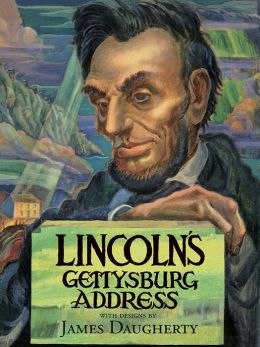
Lincoln's Gettysburg AddressPresident Lincoln delivered the Gettysburg Address 150 years ago, in late 1863; the text of that speech formed the basis for this picture book from James Daugherty, a Newbery-winning illustrator, which was first published in 1947.

The book opens with Daugherty’s original foreword, as well as the address in its entirety, before moving on to 15 paintings that depict
 muscled pioneers settling the American West, the bloody toll of the Civil War, and events well beyond Lincoln’s time, up through WWII.
The images have the heroic feel of WPA posters, as people from all backgrounds and ethnicities join together to embrace the hope and promise embodied in Lincoln’s speech. An afterword by Civil War scholar Gabor Boritt is new to this edition, as are brief guides to each painting.

KIRKUS REVIEW

Only a few presidential quotes or speeches have outlasted the test of time, and Lincoln’s Gettysburg Address is probably the most famous and most significant.

Originally published in 1947, this pictorial version has been updated with a new afterword by Gabor Boritt, a Civil War scholar, in time for the 150th anniversary of the speech. The original illustrations by Daugherty are brightly hued and hewn and dramatize the 15 sentences of Lincoln’s speech with great vigor in a style evocative of Depression-era WPA murals.

Abraham Lincoln, U.S. President. Seated portrait, facing right by Anthony Berger in 1864 In another picture-book depiction, Michael McCurdy’s black-and-white engravings (1995) contrast sharply and are forcefully composed, alternating between the action of battle and the quiet artifacts left behind. 

Daugherty’s heroic tableaux attack the emotions with highly symbolic imagery. “A new nation conceived in liberty” depicts two men, black and white, raising a flag while another white man unshackles a beaten, scarred slave; on the right, a woman, her children and her frontiersman husband look on; above all, a bald eagle flies into the sun. 

It is my hope some of you will take a look at this worthy book for children.  President Lincoln has long been a role model for people of all ages and of many nationalities as well.

Monday, February 18, 2013

New Children's Book on the Old City of David


A new historical fiction book for kids hopes to bring the story of Old Jerusalem to kids who are just starting to read.

Danny Publishers
 Several books about the Old City and the Jewish roots of Jerusalem are in the works, with one book, called An Adventure in the City of David, already on bookshelves.

The book, in easy Hebrew, is geared for the kindergarten crowd, but adults have been seen reading it as well, say its publishers, Danny Publishing. The book, by Aharon Horowitz, tells the story of the City of David, the area outside the Old City that was first built by King David. The area is rich in archaeological detail, and the book is an attempt to bring this history to young children.

The book revolves around Ori, who, together with his archaeologist uncle, goes on a time-capsule adventure in the neighborhood, uncovering discoveries about the wars, communities, kings, and daily life of the City of David throughout the ages.

The  book is illustrated with rich, deep colors, and includes time lines, easy to understand explanations of difficult concepts, and inviting graphics.

It also includes information about the Old City walls, ancient Hebrew script, and archaeological sites. The drawings are based on historic photos and documents of the area.
The book is currently available only in Hebrew, but the publishers say they are considering an English-language edition as well, if demand justifies it.

Thursday, February 14, 2013

The Daily Routines of Famous Writers


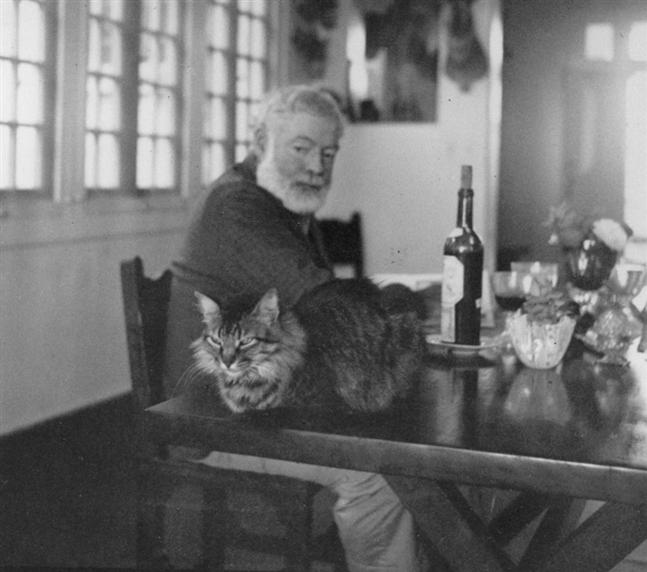
What do you do all day?  I am asked this question constantly. While never putting myself in the realm of such authors as Hemingway or de Beauvoir, I thought it might be fun to take a look at the daily routines of famous authors.  Thank you, Maria Papova for the article and Adrienne Evans, for sending it to me!  Let's begin with Ernest Hemingway:

"When I am working on a book or a story I write every morning as soon after first light as possible. There is no one to disturb you and it is cool or cold and you come to your work and warm as you write. You read what you have written and, as you always stop when you know what is going to happen next, you go on from there. You write until you come to a place where you still have your juice and know what will happen next and you stop and try to live through until the next day when you hit it again. You have started at six in the morning, say, and may go on until noon or be through before that. When you stop you are as empty, and at the same time never empty but filling, as when you have made love to someone you love. Nothing can hurt you, nothing can happen, nothing means anything until the next day when you do it again. It is the wait until the next day that is hard to get through."

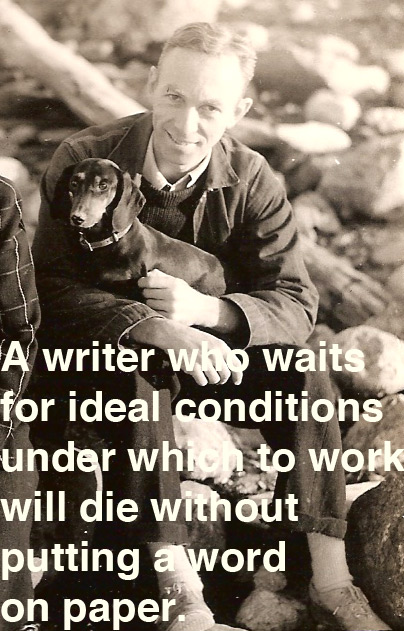
As for E.B. White:

"I never listen to music when I’m working. I haven’t that kind of attentiveness, and I wouldn’t like it at all. On the other hand, I’m able to work fairly well among ordinary distractions. My house has a living room that is at the core of everything that goes on: it is a passageway to the cellar, to the kitchen, to the closet where the phone lives. There’s a lot of traffic. But it’s a bright, cheerful room, and I often use it as a room to write in, despite the carnival that is going on all around me. A girl pushing a carpet sweeper under my typewriter table has never annoyed me particularly, nor has it taken my mind off my work, unless the girl was unusually pretty or unusually clumsy. My wife, thank God, has never been protective of me, as, I am told, the wives of some writers are. In consequence, the members of my household never pay the slightest attention to my being a writing man — they make all the noise and fuss they want to. If I get sick of it, I have places I can go. A writer who waits for ideal conditions under which to work will die without putting a word on paper."

Jack Kerouac  says:

"I had a ritual once of lighting a candle and writing by its light and blowing it out when I was done for the night … also kneeling and praying before starting (I got that from a French movie about George Frideric Handel) … but now I simply hate to write. My superstition? I’m beginning to suspect the full moon. Also I’m hung up on the number nine though I’m told a Piscean like myself should stick to number seven; but I try to do nine touchdowns a day, that is, I stand on my head in the bathroom, on a slipper, and touch the floor nine times with my toe tips, while balanced. This is incidentally more than yoga, it’s an athletic feat, I mean imagine calling me ‘unbalanced’ after that. Frankly I do feel that my mind is going. So another ‘ritual’ as you call it, is to pray to Jesus to preserve my sanity and my energy so I can help my family: that being my paralyzed mother, and my wife, and the ever-present kitties. Okay?  The desk in the room, near the bed, with a good light, midnight till dawn, a drink when you get tired, preferably at home, but if you have no home, make a home out of your hotel room or motel room or pad: peace."
  
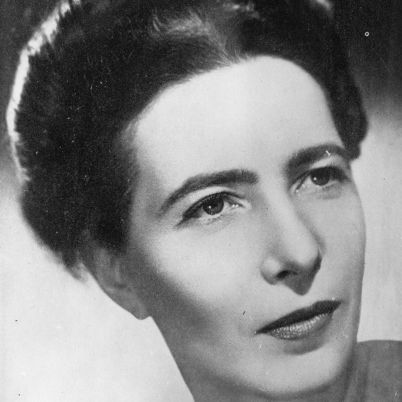
And on to Simone de Beauvoir 

"I'm always in a hurry to get going, though in general I dislike starting the day.  I first have tea and then, at about ten o’clock, I get under way and work until one. Then I see my friends and after that, at five o’clock, I go back to work and continue until nine. I have no difficulty in picking up the thread in the afternoon. When you leave, I’ll read the paper or perhaps go shopping. Most often it’s a pleasure to work.

If the work is going well, I spend a quarter or half an hour reading what I wrote the day before, and I make a few corrections. Then I continue from there. In order to pick up the thread I have to read what I’ve done."

And there you have it.  I hope you found this post informative as well as amusing!

Sunday, February 10, 2013

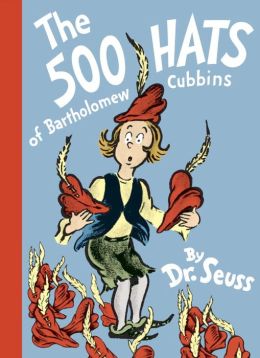
The 500 Hats of Bartholomew Cubbins by Dr. Seuss is Seventy-Five Years Old!

I have a soft spot in my heart for this Dr. Seuss classic.  I used to read it to my students when I taught elementary school.  Have a look at what is happening to the book.

500 Hats of Bartholomew CubbinsAccording to Publishers Weekly, he was a man of many hats, both literally and figuratively. As Dr. Seuss, the prolific children’s author, he wrote 46 books for children, and as Theodor Seuss Geisel, he was an ad man and political cartoonist who collected hats, hats, and more hats – much like the title character in his 1938 classic, The 500 Hats of Bartholomew Cubbins.

In honor of the 75th anniversary of that title, Random House Children’s Books, which has sold 600 million Seuss books in 30 languages and 95 countries, is launching Hats Off to Dr. Seuss!, a yearlong celebration of the good doctor with a focus on some of the issues dear to his heart – children’s literacy and health, and the joy that creativity could bring them.  The commemoration includes several programs in honor of Geisel, who died in 1991 at age 87.

The author had a private collection of hats, said to number in the hundreds.  Geisel began collecting hats in his 20s and was known to wear them – and insist his editors wear them – when in need of inspiration for a word or a character. The star of the show is undoubtedly the tall red-and-white-striped topper sported by the wily feline star of The Cat in the Hat (1957).

In a partnership with Dr. Seuss Enterprises and the Jeff Gordon Children’s Foundation, an organization dedicated to finding a cure for pediatric cancer, Random House will donate Seuss books and Seuss-themed hats to children’s oncology hospitals in the JGCF network.

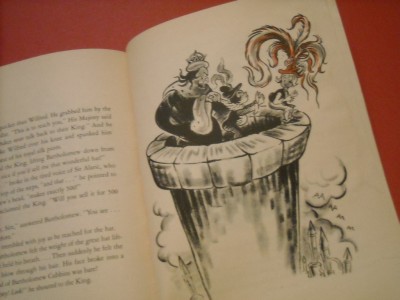
For its 75th anniversary, The 500 Hats of Bartholomew Cubbins has been converted to full color – the first Seuss title to get such a treatment.

 Originally published in black and white with flashes of red for the hats that magically appear on the title character’s head each time he removes one, the new edition, published in January, now features greens, blues, and yellows. 

It should be a fun read in its new colored state.  A renaissance of sorts for a classic.

Saturday, February 9, 2013

Children's Book Sales Down in September, 2012


Ah, yes.  The book market can be so fickle.  As in the stock market, it rides the waves of public opinion, hunches and word of mouth.  Have a look:

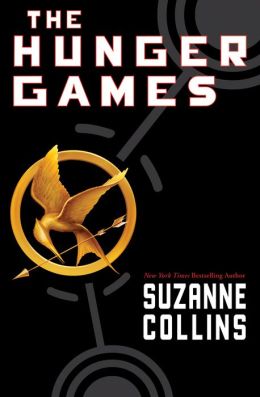
The Hunger Games (Hunger Games Series #1)Overall sales of children’s books were down in September 2012 over the same period in 2011, according to the 21 publishers reporting figures to the AAP.  In September 2011, the category saw estimated total sales of $151.9 million; in September 2012, that number fell to $145.6.

 Paperbacks showed the most significant decline, of almost 17%.   Nielsen BookScan figures suggest one cause – steep declines for the first Hunger Games book (which had been riding high in 2011 in the wake of the film's release.)

The Red Pyramid (The Kane Chronicles, Book 1)The debut Kane Chronicles title (whose paperback launched with a big splash mid-August 2011) also figured in with a less that stellar continuing performance.

Hardcover sales dipped slightly, by just under 4%, and e-books continue their reign, with a 44.4% jump over last year.

This information came from Publishers Weekly.

Wednesday, February 6, 2013

Guess Who Has Turned 50!


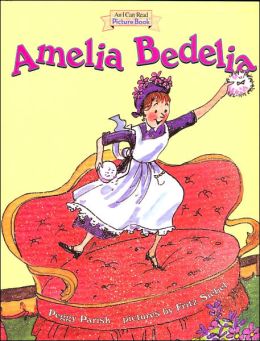
Amelia Bedelia, has turned 50, with new books to celebrate the event!

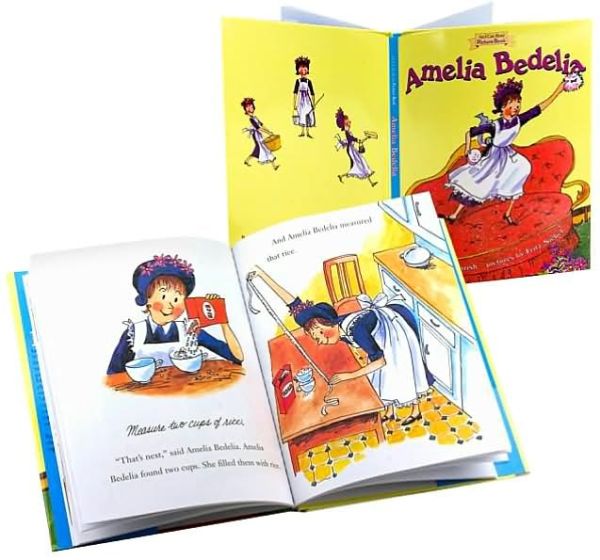
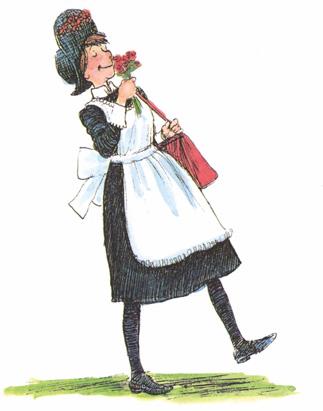
Amelia Bedelia (I Can Read Book Picture Book Series)The late author Peggy Parish wrote the first Amelia Bedelia book in 1963, eventually writing a dozen picture books that chronicled the oh, so literal house maid, who  sketched curtains on a piece of paper when asked to "draw the drapes."

 Greenwillow Books, the book series' publisher, which is a division of Harper Collins, is releasing a 50th anniversary edition of Amelia Bedelia with drawings by the original illustrator Fritz Siebel and a behind-the-scenes look at how the series evolved.
Amelia Bedelia (I Can Read Book Picture Book Series)
What readers may not know is that Peggy Parish's nephew, Herman Parish, has continued where his aunt left off when she died in 1988. Parish, 60, has written 27 Amelia Bedelia titles in all, including the first two Amelia Bedelia chapter books.


"Amelia Bedelia Means Business" and "Amelia Bedelia Unleashed" showcase her character as a young girl.  Usually, publishers release series books one after the other. But that didn't happen with Amelia Bedelia's chapter books.

Amelia Bedelia Through The YearsThey have 160 pages each and mark a new era for the brand, which previously captivated children with 30 or so pages of artful illustrations.

In total, more than 35 million copies of the Amelia Bedelia books have been sold, plus 11 million more through licensing deals with children's publisher Scholastic.

Virginia Duncan, editorial director at Greenwillow, said the staff always looked forward to working on the next Amelia Bedelia book, not just for the character's memorable antics but because she "loves life."

Sunday, February 3, 2013

Using Deep Point of View in Children's Books

I wrote this post last week for my regular guest spot on Donna McDine's wonderful blog, Write What Inspires You.  It is a timely topic in the writing world, so I'm doing a reprise here in case anyone would enjoy reading about this useful technique of getting into one's character's head!

Rivet Your Readers with Deep Point of ViewDeep Point of View?  What is it?  Never heard of it.  But I'd like to know more. 

These are the kinds of answers I get many times when I mention this technique of writing. I thought it just may be time to discuss this effective way of truly getting into one's character's head and staying there.  It's time to give the pesky narrator the boot!  Goodbye, author intrusion.

Deep Point of View, sometimes called Close Third Person, can be used with First Person as well and is a writing style in great demand these days.

The reader climbs into their protagonist's skin—tasting, feeling, hearing, smelling what they do.  Deep POV is a skill that must be learned, like anything else. But the four tips below are a great place to start.
(The before and after examples are from my middle grade manuscript Lost on the Skeleton Coast.)
Tip 1: Delete the phrase "s/he saw"

Obviously not every use of the word saw (observed, noticed, wondered, etc.) will be slashed. But go through your manuscript looking for lines like these:
Olivia smiled at her uncle. She saw that he was really into it now. 
And change to:
Olivia smiled at her uncle. He was really into it now. 
State the action only. Saw always distance the reader. Bring the reader up close instantly.


Tip 2: What words would you say in the manuscript?

Use realistic internal dialogue. What you would say to yourself if you were living the scene, then replace the pronouns with "s/he" (unless you're writing in first person, of course.) 

The Emotion Thesaurus: A Writer's Guide to Character ExpressionExample:   She felt the knife's blade rub her throat.  The metal felt so cold.  She had to stay still and keep from blinking. Olivia was panicked. 
Deep Point of View:  The knife's blade rubbed her throat.  Why was the metal so cold?  Sweat dripped into her eyes, burning them.  What does it feel like to die?

Tip 3: Don't label emotions.

This is classic show vs. tell but is vital to Deep POV. Delete from your mind the name we give to an emotion and force yourself to describe it.  What physical movements would show the emotion without naming it?
Example: Anger 
Olivia was angry.

becomes:   Olivia's eyes became slits. 

Tip 4: Physiological responses

Once you lay out some strong internal dialogue and remove emotion labels, follow up with physiological responses. Depending on the situation, these might be knees buckling, throat clamping, an adrenaline rush, goose bumps, nausea, dizziness, sweating, etc. Describe those. This will really pull the reader deep into the story, particularly in high-intensity moments.
Example:  Excessively hot
Olivia was too hot.
becomes:  If only Olivia could remove the enormous blanket of heat bearing down on her.  Breathing hard, sweat poured from her body and dried quickly.  "We all have to drink, or we're not gonna make it."  A frog's croak.  Was that her voice?
 
I hope this post has encouraged you to throw out all the distance-making words in your manuscript.  Let yourself be invisible.  Allow your protagonist to shine through those pages.  You'll be happy with the results, and so will your readers!

Wednesday, January 16, 2013

New Study Finds the Number of Kids Reading eBooks Has Nearly Doubled Since 2010

Have a look at this interesting study from Scholastic.  Not surprisingly, ebook reading has exploded and will continue in that vein, I have no doubt.  Take a look at the material, and see what you think!


In the fourth edition of the Kids & Family Reading Report™ , a national survey released today, kids age 6-17 and their parents share their views on reading in the increasingly digital landscape and the influences that impact kids’ reading frequency and attitudes toward reading.
The study, a biannual report from Scholastic (NASDAQ: SCHL), the global children’s publishing, education and media company, and the Harrison Group, a leading marketing and strategic research consulting firm, reports that:
  • The percent of children who have read an ebook has almost doubled since 2010 (25% vs. 46%).
  • Half of children age 9-17 say they would read more books for fun if they had greater access to ebooks – a 50% increase since 2010.
  • Overall, about half of parents (49%) feel their children do not spend enough time reading books for fun – an increase from 2010 when 36% of parents were dissatisfied with time their child spent reading.
  • Seventy-two percent of parents show an interest in having their child read ebooks.
Findings reveal the potential for ebooks to motivate boys, who are more commonly known to be reluctant readers, to read more.
  • One in four boys who has read an ebook says he is now reading more books for fun.
eBooks may also be the key to transition moderately frequent readers (defined as kids who read one to four days a week) to frequent readers (those who read five to seven days a week).
  • More than half (57%) of moderately frequent readers who have not read an ebook agree they would read more if they had greater access to ebooks.
Even so, the love of and consistent use of print books is evident among kids, regardless of age.
  • Eighty percent of kids who read ebooks still read books for fun primarily in print.
  • Fifty-eight percent of kids age 9-17 say they will always want to read books printed on paper even though there are ebooks available (a slight decline from 66% in 2010), revealing the digital shift in children’s reading that has begun.
"We are seeing that kids today are drawn to both print books and ebooks, yet ereading seems to offer an exciting opportunity to attract and motivate boys and reluctant readers to read more books," noted Francie Alexander, Chief Academic Officer, Scholastic. "While many parents express concern over the amount of time their child spends with technology, nearly half do not have a preference of format for their child’s books. 

The message is clear – parents want to encourage more reading, no matter the medium.

The report also notes that the gender gap in reading frequency and attitudes towards reading is narrowing; however, the narrowing of the gap is driven more by decreases among girls than it is by increases in boys.
  • Among girls since 2010, there has been a decline in frequent readers (42% vs. 36%), reading enjoyment (39% vs. 32% say they love reading), and the importance of reading books for fun (62% vs. 56% say it is extremely or very important).
  • Among girls ages 12-17 there was an increase in the amount of time they spend visiting social networking sites and using their smartphones for going online.
  • Among boys since 2010, there has been an increase in reading enjoyment (20% vs. 26% say they love reading), and importance of reading books for fun (39% vs. 47%). Reading frequency among boys has stayed steady, with 32% being frequent readers.

The study also looked at the influences that impact kids’ reading frequency, and parents ranked extremely high. The report found that having a reading role-model parent or a large book collection at home has a greater impact on kids’ reading frequency than does household income. Plus, building reading into kids’ daily schedules and regularly bringing home books for children positively impacts kids’ reading frequency.

Sunday, January 13, 2013

Namibia: Wordweaver Launches New Publishing House

Wordweaver is a new Namibian Publishing House which was launched in Windhoek the capital, in March, 2012.  The company believes that there is a world-wide audience for their stories.  So do I.  Their book offerings are bright, fresh and original.

Wordweaver PublishingWordweaver Publishing House received two gold awards at the Namibian Children’s Book Forum Awards ceremony, held in October, 2013.  An incredible achievement for the fledgling publishing house, which launched its first titles only ten months ago.  They have added another lovely title with the launch of their book 'Sumbu'.
Sumbu

The  beautifully illustrated story is  based in rural Namibia.  It is a tale of  Sumbu and her family at the time of Namibia's independence as they return from exile. They settle in a village, but not all inhabitants are happy about the new arrivals.  Through this magical story, the village learns the power of togetherness and caring for one another.

Author and illustrator Romeo Senkala says:

Welwitschia's World
Our stories, ancient and new, need to be told in all forms of media. Our stories sustain our identity as a people. We, the creatives, are agents of this heritage.

The book is available at all Wordweaver book stores as well as online at:   
 http://wordweaverpublishing.com


Thursday, January 10, 2013

New children's Book Series on American Government


With the presidential inauguration just a couple of weeks away, the intervening time makes a great opportunity to get young people excited about the workings of American government. These new series provide access points that are engaging and informative.

The first series, “I’m an American Citizen” (Powerkids Press), features titles that provide basic information on citizenship. Written for early elementary school children, the text consists of three to five simple sentences per page. Large colorful photographs support the text.

Titles in this series include “The Many People of America” by Joanna Anderson; “Our Country’s Holidays” by Janice Charleston; “Electing Our Leaders” by Earl McGraw; “Let’s Volunteer” by Richard Pickman; “What Are Rules and Laws?” by Ellen Ripley; and “The Songs We Sing: Honoring Our Country” by Harriet Wesolowski.

A Kid's Guide to the Voting Process (Vote America)Another series, “Vote America” (Mitchell Lane Publishers), is geared for third- to fifth-graders. This series focuses on political parties and the voting process. Information covers how the Electoral College works, voter qualifications, election platforms through the years and ideas for youth involvement in politics.

Colorful illustrations complement the concise, accessible text perfectly. Titles include “A Kid’s Guide to the Voting Process” by Tammy Gagne, “A History of the Republican Party” by Jane Amie, “A History of Voting Rights” by Tamra Orr and “A History of the Democratic Party” by Russell Roberts.

I hope you may take a look at some of these books or others that have been published in advance of the new term of the US presidential inauguration and administration.

Monday, January 7, 2013

How to Avoid the Feeling of Isolation by Conducting Author Visits by Donna McDine

I am delighted to resume our monthly guest posts with author and Editor-in-Chief of Guardian Angel Kids, Donna McDine.  Welcome, Donna!


Your writing career is moving at a steady pace, but from time-to-time, the feeling of isolation overwhelms you. What is a writer to do to get one’s self out into the world of the living, but not neglect your writing goals?  One of the best ways to get yourself known locally as a serious writer would be to participate in author visits to elementary schools, middle schools, and high schools in your area - depending on what genre you write for. Also check out your local library and bookstores – they too may be interested in having you conduct an event. Presenting your short story or non-fiction article for children’s magazines can be fun way to present the creative writing process to children of all ages without overwhelming them. And since you are writing for children, why not spend time with them? 


It can be daunting to research school visits, considering the Internet comes up with over 2 million hits when typing in “School Author Visits.”  Why not check out the following resources:

1.      Local Schools –Contact an elementary school in your area and find out whom you need to present your school visit request to. The school secretaries are happy to point you in the right direction, whether it is the principal, PTA or program coordinator of the school. IMPORTANT: Keep in mind you don’t necessarily need to have a published book to conduct a school visit. You may be able to present a published short story or non-fiction article to the class. In addition, let the school know that you can meet with respective teachers and conform the event to coincide with their ELA State Assessment Guidelines.


One of Donna's Author Visits
2.      Your network of fellow writers – We are all cheering for one another and I’m sure your network would be happy to discuss their ideas of school visits. If you are just starting out, the Society of Children’s Book Writers & Illustrators – http://www.scbwi.org, has a wealth of information on all topics for writing for children.


3.      Local Librarian – I have had wonderful success in becoming “buddies” with my local librarian. They are a chock full of information when it comes to conducting events for children. You never know, they may be so impressed with your initiative that they may request that you conduct a visit at their library. What better way to keep children inspired to read by meeting a local writer living in their midst?


4.      Local Bookstores – Approach the manager or owner to see if they would be interested in having you conduct an author visit. If they are, obtain their guidelines for conducting such a visit and tell them that you will get back to them with your proposal / school visit kit. Be sure to leave your business card with them.


Put yourself out there…it will not only be fun for the children but for yourself!

Bio: Donna McDine is an award-winning children's author, Honorable Mention in the 77th and two Honorable Mentions in the 78th Annual Writer’s Digest Writing Competitions,  Literary Classics Silver Award & Seal of Approval Recipient Picture Book Early Reader, Global eBook Awards Finalist Children’s Picture Book Fiction, and Predators & Editors Readers Poll 2010 Top Ten Children’s Books ~ The Golden Pathway. 
Her interest in American History resulted in writing and publishing The Golden Pathway. Donna has four more books under contract with Guardian Angel Publishing, Hockey Agony, Powder Monkey, A Sandy Grave, and Dee and Deb, Off They Go. She writes, is Editor-in-Chief of Guardian Angel Kids, moms and is a personal assistant from her home in the historical hamlet Tappan, NY. McDine is a member of the SCBWI, Children’s Literature Network, and Family Reading Partnership. Visit www.donnamcdine.com. 

Thursday, January 3, 2013

New Children’s Book Helps Empower Kids to Find Their Voices


S. Renee Mitchell hopes to boost children’s self-esteem with her new children’s book The Awakening of Sharyn: A Shy and Brown Supergyrl.

The Awakening of Sharyn - Portland, OR“The book is about finding your voice,” says Mitchell. “If they’re going into the 1st or 2nd grade not feeling like they have that confidence, they don’t really have what it takes sometimes to do the work because they already assume they aren’t worthy.”

The book, written and illustrated by Mitchell, includes a parent workbook that attaches artwork with discussions on concepts like teacher bias, facing your fears and birth order. She says the book is more than just a “cute story." It offers the opportunity for parents to have conversations with their kids, as well as increase children’s literacy.

Mitchell’s book focuses on a brown girl, Sharyn, who goes to school with mostly white kids who assume she’s not as smart because of the color of her skin. Sharyn feels invisible because other kids see her skin and her hair but don’t see her as a person beyond the stereotypes. Once she gets tired of being bullied, she finds her voice and becomes a “supergyrl."

“Not a ‘supergyrl’ in the sense that she can fly or walk through walls but super from a strength based perspective,” says Mitchell. “The things that I have inside of me right now that I exhibit like kindness, courtesy, compassion and sense of humor, all of those are superpowers we should celebrate in kids. It lets them know they can do something really great right now.”

Cover Photo
The idea for the book came about when Mitchell was working with first graders at King School. She was doing a name exercise where she would have students attach a positive adjective to their names. Mitchell says she was giving children suggestions but some couldn’t connect because they were so shy.  She went home heartbroken and decided she wanted to do something. The result was a children’s book.

Mitchell says she can relate to Sharyn because she was a shy girl too.

I was shy to the point that if you looked at me too long I’d start crying. At the same time I felt invisible. People would overlook me unless they wanted someone to tease.

Writing the book was personally healing, says Mitchell. In addition to the personal nature of the story, it is also the first thing she has illustrated as an adult.  Although she used to draw when she was younger, she says it was more of her brother’s interest. Whatever made drawing exciting to her was lost.

Photo: Some more of my favorite people in Portland support the Sharyn empowerment project!
In her efforts to empower kids, Mitchell has made paraphernalia to accompany her book, including buttons, earrings and affirming cards that say things like, “Sharyn says: Courage is my new bff”.  She is also in the process of recording the book for pre-readers.

Mitchell hopes to bring a superhero awakening ceremony to Kwanzaa celebrations this year. During the ceremony, kids are provided capes and masks and asked to select a superpower. Once they’ve done that, they perform a ritual where they pose in a way that fits with their superpower and the adults gather around them to sing superhero songs.

Although she hopes to empower Black and Brown children in particular, Mitchell says the universal message can appeal to everyone.  “Even though it’s a children’s book I think it has a lot of relevance for adult women,” she says. “It talks about facing your fear. Fear is something we all have at any age.”

“The Awakening of Sharyn: A Shy and Brown Supergyrl” is available at:  www.reneemitchellspeaks.org.

Tuesday, January 1, 2013

A New Year's Eve, Unplanned

Happy New Year's Day to you all!  Today is a quiet one for me, packing up the beach condo and leaving for Tampa later this evening.  No lingering memories of a lovely New Year's Eve party, no gathering up champagne bottles to be recycled, no pesky stains on a favorite tablecloth waiting to be tackled--once again.  My New Year's Eve was of a different nature this year.  And it was just fine. 


Leah and Paige
(And Lucy)
My family and I spent the last of the holidays with our son and his family in Los Angeles.  Every moment of it was wonderful.  Our two granddaughters, Leah and Paige, were and are so much fun and uplifting in every way.  We reveled in being together, entertained in their beautiful new  (old) house and felt valued to have such a family.

Uncle Brian, Paige, Leah
  At the end of our time, I had a sniffle or two, but it was the holidays, after all.  Our daughter-in-law, Ali, an emergency room doctor, called in a prescription--to be sure.  And was she right!  No details, but I feel terribly sorry for the people sharing the plane with me...

As to holiday plans, they evaporated like the holidays themselves.  My husband and Louie, our Shih-Tsu and Bichon mix puppy and I sat on the sofa and watched an old film  (not quite sure Louie understood the nuances).  We opened a bottle of Prosecco, a gift from a friend, and shared it.


Louie
All this to say my New Year's Eve was a good one, even though unanticipated.  A sinus infection is just that, nothing serious or life threatening.  One recovers and moves on, and so I am blessed.  With good health, a loving family and fine and constant friends.

I wish the same happy situation for all of you.  Here's to the best of 2013!