Friday, August 26, 2011

Dolphins' Amazing Ability to Heal after Shark Attachs-Scientists Are Asking Why?

The dolphin has amazed us with its intelligence.  Now it turns out that it routinely defies death.  It can ignore a wound that would kill a human within hours. Dolphins, according to a new study, are frequently attacked by sharks that leave gaping holes bigger than a basketball.

PHOTO: Bottlenose dolphins"Why don't they bleed to death?" asks Michael Zasloff, professor of surgery and immunology at Georgetown University Medical Center. "Why don't they get infections? Why aren't they eaten after the injury? Why doesn't the shark finish the job?"  Zasloff thinks he may have at least partial answers to those questions, although much more research needs to be done.

"I have concluded that what we see when we look at the dolphin is a medical miracle," he said. "And if scientists can figure out exactly how the dolphin cheats death, maybe humans can eventually learn how to do it too, through better treatment of all sorts of injuries, not just shark bites. "

Zasloff is a surgeon, not a dolphin expert, but his interest in this sea-going mammal began nine years ago, when he was visiting a marine lab in Scotland. He was told that 70 to 80 percent of the dolphins that swim in the waters near Australia have shark bites.

"When I heard that I was taken aback," he said. "How in the heck does a mammal, like you and me, survive a shark bite in the ocean, unattended, with no antibiotics?"

A shark bite involves more than just ripping out a large chunk of flesh. The shark leaves "the worst collection of toxic organisms" in the wound, so infection should follow. A human being would die of infection and shock within two or three days if not hospitalized. So how does a dolphin heal itself without medical treatment?

That question haunted Zasloff for nine years, but a few months ago, he began working with Australians who are in constant contact with bottlenose dolphins, including Trevor Hassard, director of the Tangalooma Wild Dolphin Resort on Moreton Island. The resort is different from most aquatic parks in that the dolphins are free to visit, where they get an easy meal, or leave and return to the wild whenever they so desire.

Over the years Hassard and others who care for wild dolphins have seen hundreds of dolphins that have been attacked by sharks. If the attack was recent, an open wound, usually on the backside of the dolphin, seemed to have little effect on the animal. It swam normally, did not show any sign of pain -- though dolphins clearly can experience pain -- and acted as though nothing was wrong. And within about 30 days the wound was gone. There were no scars. No signs of the injury. Even the natural contour of the body was back to its normal shape. So the dolphin doesn't just recover from the attack. It regenerates the blubber and refills the hole!

Zasloff theorizes --just a theory at this point -- that the injured dolphin can produce stem cells that can morph into whatever is needed to fill in the wound. Perhaps, he speculated, it has some sort of a growth hormone that stimulates the production of stem cells, and maybe that same hormone would work for other mammals, including humans.

During that month-long healing process, the dolphin is exposed to all sorts of pathogens that should cause potentially fatal infections, but that doesn't happen. Perhaps, he suggested, the dolphin carries its own packet of antibiotics.

There is a lot of research on the composition of the blubber, and it includes "compounds that look a lot like the antibiotics that other sea creatures have to protect themselves," like algae and plankton, Zasloff said.

Maybe when the dolphin consumes those other creatures, it doesn't metabolize the natural "antibiotics" and return them to the sea. It could be that it stores those vital compounds and deploys them to an injury inflicted by a shark.

"It's not breaking them down," Zasloff said. "It's storing them in the blubber. It's as if the dolphin has decided to keep the good stuff that is made in the ocean by other creatures to fight bacteria."  But what about the pain? The Australian caregivers say dolphins attacked by sharks don't act as if they are in pain at all.

Zasloff theorizes -- and this is just theory at this point -- that the injured dolphin can produce stem cells that can morph into whatever is needed to fill in the wound. Perhaps, he speculated, it has some sort of a growth hormone that stimulates the production of stem cells, and maybe that same hormone would work for other mammals, including humans. A lab with access to injured dolphins should be able to isolate the hormone, if it's there, he said.

There is a lot of research on the composition of the blubber, and it includes "compounds that look a lot like the antibiotics that other sea creatures have to protect themselves," like algae and plankton, Zasloff said  He suspects the animal not only carries antibiotics -- it also comes equipped with built-in painkiller.

"I propose that the wound itself is releasing a pain-relieving substance, and it must be unbelievably powerful. It has to be activated at the site of the wound, and it is not going to be addictive. I would say that is perhaps the most miraculous of all," he said.  It carries its own anesthesia?  "I would call it morphine," he added. "I think we'll find it in the tissue."

But that leaves us with a final question. Why didn't the animal bleed to death in the minutes after the attack?  "That's the easy one," Zasloff said.

The dolphin probably goes into a deep dive right after the initial attack in an effort to escape, and during the dive it will need all its available blood to pump oxygen to the brain. So it shuts off the blood flow to much of the rest of its body, including the wound.
By the time the animal surfaces -- maybe 20 minutes or so later -- the small amount of blood in the wound would have coagulated, closing down any possible bleeding.  It will be a while before we know if he's right. If so, the dolphin is much more fascinating that we ever imagined.




Wednesday, August 24, 2011

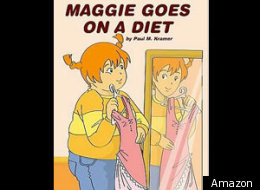
"New Children's Book, "Maggie Goes On A Diet" Raises a Storm of Protest Here and Abroad

Have you seen this book advertised or discussed in articles and blogs yet?  It's the one with the conundrum following it like the tailwind of a Sahara sandstorm.

 An overweight young girl with braids, stands in front of the mirror holding up a too-small pink dress and sees a new and improved version of herself. The girl looking back at her is thin.

This book that many find disturbing at best and harmful at worst, will be in bookstores on October 16.  It was written and self-published by Paul M. Kramer.

Amazon recommends the book for children beginning at age six.  The beginning grade recommendation is First Grade. The Amazon description reads:
"This book is about a 14 year old girl who goes on a diet and is transformed from being extremely overweight and insecure to a normal sized girl who becomes the school soccer star. Through time, exercise and hard work, Maggie becomes more and more confident and develops a positive self image. 
Teenage Weight Issues Teaching kids to make healthy lifestyle choices from an early age is a worthy endeavor.  And childhood obesity is a serious public health issue nationwide. According to the CDC, approximately 17% of children in the US are overweight.  This is over triple the rate a generation ago.

But Maggie isn't dreaming of being a soccer star. This little girl is driven to get into the pink dress. The book is selling skinny first with everything else to follow.

Just as childhood obesity is on the rise, eating disorder rates are climbing alarmingly and are affecting younger and younger kids. Last year, the American Academy of Pediatrics reported a 199% increase in the number of eating disorder-related hospitalizations for children under the age of 12.

Whether the book sells well or is effective in its message, remains to be seen.  This blogger, though, will leave her readers with one notion.  The emphasis is misguided from the beginning of the book.  Children are not the ones to be targeted and certainly not children as young as six! It is, in fact, parents who need to be educated and become proactive about this national epidemic. Only then will there be any hope of eliminating such an emotionally wrenching and potentially life shortening problem.


Monday, August 22, 2011

For Relunctant Readers--"The World's Most Haunted Places"

Disembodied voices, ghoulish apparitions, and a death tunnel are just some of eerie subjects readers will encounter in Matt Chandler’s new children’s book, “The World’s Most Haunted Places.”
World's Most Haunted Places (Edge Books: The Ghost Files)
Chandler explores supernatural phenomena both here and abroad, including hauntings in the The Borley Rectory in Essex, England, The Amityville House in New York and The Stanley Hotel in Colorado, which inspired Stephen King’s horror novel, The Shining.

The 32-page work of non-fiction is part of “The Ghost Files” book series by Capstone Press, and geared toward children ages 9 through 12.

A professional journalist, Chandler is the associate editor of the Buffalo Law Journal, the legal reporter for its sister publication, Buffalo Business First.

Despite his extensive writing background, Chandler said that creating a children’s book was quite a different experience.  He explained that one of the more challenging aspects of writing in the genre was taking an intense and somewhat terrifying subject, like hauntings and evil spirits, and making it appropriate for children. While he wanted to include what he deemed “juicy stories,” he was careful not to cross any lines.

Nevertheless, Chandler credited children for their ability to handle and process information.  “Kids today are not typical anymore,” he said. “They are much smarter and so much more dialed in than in years past.”

Chandler also made sure to employ language that would challenge young minds. The more difficult terms are highlighted within his text and included in a glossary at the book’s end.

Capstone Press’ books are specifically designed to engage students that may not be interested in or proficient at reading, Chandler explained. Photographs and fact boxes that accompany the main text help to hold readers captive.

A stipulation Chandler set for himself when writing “The World’s Most Haunted Places” was to keep his personal beliefs regarding ghosts and the supernatural out of the book. “At the book’s end, it does not tell you if ghosts are real or fake,” he said. “That’s not the point. The point is to make children reason and think for themselves.”


Friday, August 19, 2011

The Help, by Kathryn Stockett-A Study in Pre-Civil Rights Mississippi Women

Talk about rejection and redemption!  Kathryn Stockett, author of the bestselling book, and now highly successful movie, The Help, received 60 rejection letters over 3 and a half years—and still didn’t give up. Good thing she didn’t.

(Be sure to view the film's trailer at bottom of post.)

The Help is a rich treatise on growing up in Mississippi.  It is written from the perspective of a white woman from the South who writes from the viewpoint of African-American maids. 

The book deals with the complicated relationships between African-American domestic servants and the white women who employed them.  Set in pre-civil rights Mississippi, the book  has spent over 30 weeks on the New York Times' best-seller list.

In the author's own words:
...A few months later, I sent it to a few more agents. And received a few more rejections. Well, more like 15. I was a little less giddy this time, but I kept my chin up. “Maybe the next book will be the one,” a friend said. Next book? I wasn’t about to move on to the next one just because of a few stupid letters. I wanted to write this book.
A year and a half later, I opened my 40th rejection: “There is no market for this kind of tiring writing.” That one finally made me cry. “You have so much resolve, Kathryn,” a friend said to me. “How do you keep yourself from feeling like this has been just a huge waste of your time?”
That was a hard weekend. I spent it in pajamas, slothing around that racetrack of self-pity—you know the one, from sofa to chair to bed to refrigerator, starting over again on the sofa. But I couldn’t let go of The Help. Call it tenacity, call it resolve or call it what my husband calls it: stubbornness.
After rejection number 40, I started lying to my friends about what I did on the weekends. They were amazed by how many times a person could repaint her apartment. The truth was, I was embarrassed for my friends and family to know I was still working on the same story, the one nobody apparently wanted to read.
Aside from being an interesting vignette about a tenacious woman who believed in her story and wouldn't let go of that belief, it is also a cautionary tale for authors and authors-in-waiting.  We write from our hearts.  We write because we have to write.  And we receive rejections.  And that can be demoralizing.  But we  cannot give up on our dream.  We should not give up our dream.  Indeed, from Kathryn Stockett's amazing journey,  let's all take heart and laugh (at least, try to) in the face of "those letters."


Tuesday, August 16, 2011

Sammy in the Sky by Barbara Walsh, Illustrated by Jamie Wyeth!

 Barbara Walsh figured the worst that could happen was he would say no.  In truth, she hardly expected any response at all. She assumed Jamie Wyeth probably would just blow her off. No way the famous painter would take the time to illustrate her children's book about the death of the family dog, she said to herself.
Sammy in the Sky"But a friend persisted. She insisted, 'Call Jamie.' I thought, 'Oh, sure -- and I'll go to the moon, too,'" Walsh said.  Walsh, a veteran newspaper reporter who has made many awkward phone calls in her life, dialed Wyeth directly.

 He encouraged Walsh to share with him what she had written.  "Send me the book," he assured her. "I'll take a look."

Months passed. Walsh rewrote and tweaked her story endlessly, all the while without a peep from Wyeth. Then one day, a letter arrived at her Winthrop home, her address printed with a flourish of bright blue ink.  She opened the envelope expectantly, and was thrilled and surprised to read that Wyeth wanted to explore collaborating further.

The result of their effort is "Sammy in the Sky," a new children's book that Massachusetts-based Candlewick Press published this week. It's a gripping and honest story about how one family coped with the death of a beloved family pet.

The title refers to Sammy's place in the clouds, where good dogs go to chase bubbles after they die. The book stars Sammy, Walsh's loyal hound, who died in 2003. The co-stars are Walsh's daughters, Emma and Nora, now 13 and 10, respectively.

Jamie Wyeth PHOTOS
Jamie Wyeth
In an interview at his home in Tenants Harbor, Wyeth said Walsh's manuscript made an immediate and lasting impact on him. He's illustrated a couple of children's books before, and he receives frequent requests to do more. But he's busy enough with his painting career that he simply can't take the time required to do justice to a book.  This one was different.

His illustrations convey the range of emotions in Walsh's story -- the joy of companionship, with Sammy gleefully licking the little girl's face, and the thrill of the chase as he bounds after gulls on the beach.

The difficult emotions are there, too -- the uncertainty in Sammy's eyes when the family learns he is sick and dying; the trepidation of the girl as she hugs her dog just before he dies; the undulating waves of grief upon his death and the pensive confusion that follows the morning after.

Jamie Wyeth Painting
"The next morning, Daddy and I went for a long walk on the beach," Walsh writes. "I searched for Sammy in the sky. I searched and searched for a cloud that looked like Sammy. I looked for his face, his paws and his big brown eyes.  "'Can't Sammy come back?' I asked Daddy. 'Just for a little while?'  Daddy shook his head. 'You'll have to remember him in your heart,' he said.

Wyeth labored over the illustrations, and treated each as a separate painting. The book includes nearly two dozen paintings, which Wyeth completed in gauche and watercolor over the course of many months.

An avowed dog lover, Wyeth saw no point in toning down the pain of loss.
"The dog dies. People get sad," he said. "Animals mean a lot to me. I spend more time with animals than I do with people. Animals are almost always loving and kind."

In his dedication, he said he illustrated the book, "For all the dogs I have loved and lost."
"Sammy in the Sky" is Wyeth's third picture book. His others, "The Stray" and "Cabbages and Kings," came many years ago. He did his work for "Sammy in the Sky" in honor of his late grandfather, the legendary illustrator N.C. Wyeth, whose work Jamie adores.

This is Walsh's first book. A second, "August Gale," is due this fall. It is a memoir geared toward adults.


Sunday, August 14, 2011

The FBI's New Missing-Child App

  
There's a smartphone application for just about everything these days. Of course, writers love the one for children's books and the promise of more of them.

Article ImageBut now the FBI has created one for parents and law officers: the Child ID app. If the worst (God forbid) happened and one's child disappeared, this app contains all the information law officers would need to begin searching.

The app provides a place to store a recent photograph of your child and identifying information for easy access in the midst of a crisis.  "If they had all the information in one place, it makes it so much easier," said FBI spokeswoman Sandy Breault.

Another feature includes a tab that emails the information to law enforcement.  And there are tips on keeping children safe and what to do in the first few hours that a child goes missing.

For now, the app is available only to iPhone users. It's free to download from the App Store on iTunes.  But plans are under way to expand the FBI Child ID app to other mobile devices.

For those without a smartphone, the FBI provides free child identification kits. They include your child's fingerprints, DNA and a spot for a recent photo and identifying information. The kits are equally effective as the app, Breault said, adding that all parents should have their child's fingerprints on hand just in case.

It is, these days especially, incumbent on us as a whole national community, to do our part to keep kids safe.  I applaud the FBI for taking this initiative to help us achieve this basic expectation concerning the safety of our children.


Friday, August 12, 2011

A Big Thank You on Thank-You Day, 2011!

This is just a quick post to say thank you to all who follow this blog!  I am so very appreciative of your support and want to say so publicly on this national day of thanks!

This blog has been up and running since December, 2010.  From the beginning, when it was not very well known, there was still a small group of supporters.  For you especially, I am so grateful.

For me, the written word is powerful and a fantastic part of the human experience.  The world can change for the better through it.  Of that I am convinced.

Again, thank you all for your ongoing support.  And the blog continues.

Wednesday, August 10, 2011

Interview with Cheryl Baker of Zen 4 Animals Jewelry

I am so happy to have Cheryl Baker as my interview guest today.  Cheryl is an artist and an avid conservationist.  She has married these two parts of her life in such a valuable and productive manner.  Let's welcome Cheryl.

Cheryl and Dixie Doodle
NS  Please tell us when you first discovered your love of and respect for animals.

CB  Since I was a very young child, I have always felt a very deep connection to animals, It was more than just loving them for me, it felt like I understood them in a way that I couldn't put into words. I would come home with fallen baby birds, injured rabbits and I was always seeing stray dogs everywhere. We seemed to always find each other.

One of my very defining moments was one night during dinner when I was about 12 years old. As I sat sharing my dinner with my dog, Sandy, I alternated glances between her and the meat that was on the table. I remember wondering if there really was a difference between my dog and the food animal.

An earlier defining moment was after reading an article in the Reader's Digest about leg hold traps and the fur industry. I was so upset that I decided at that time to always help animals.
I would go to bed at night praying for all animals to have wings so they could fly away if they had to.
MyZenAssistant.JPG
Fancy Face
NS  In what ways has your life been defined by this passion?

CB  Everything in my life has been defined by my passion and love for animals. From the cosmetics I choose being 'cruelty-free' (no animal testing) to the foods I eat. My journey has always been to choose kindness and compassion - everything else happens around that to light the way to who you are.
Through the years since childhood I've always chosen the 'rebel with a cause' path. I was inspired to protests against pigeon shoots, giving presentations about animal welfare, working with rescues and my work undercover in a research testing lab where they used animals to test cosmetics and household products. You can read about my experience in an article I wrote, “A Bunny Would Never Wear Mascara.”

Even the cars I choose in some way had animals at the heart of it. Well, at least one car I drove long ago that had a small hole in the back floorboard. I made the hole 'cat-size' and put blankets and pillows inside for the stray cat colony living behind my apartment complex. I felt bad when I had to evict them all, so I could go to work. I eventually found homes for them - (mostly my home).

NS  The Deepwater Horizon oil spill was very personal to me.  In what ways did it impact your life?

CB  I don't live close enough to have been impacted on a physical level but the disaster was a heartfelt reality of what consequences human mistakes can have on animals and our environment. It also was a reminder of how we can work together for the benefit of animals in a crisis. I believe there is always more good than bad and we need to focus on the positive aspects in any situation.

NS  Tell us about your animal jewelry and how that came about.

CB  I'm not sure, but I really think one of my cats insisted on it...:)   I've always loved creating things and one day while sitting at the table teaching myself how to make jewelry, one of my rescue cats,Fancy Face, jumped up and just sat there staring at me among my jars of beads and findings. In that moment she became my Zen Assistant and my jewelry business, Zen 4 Animals Jewelry, was born.

New items and new ways to help animals...

NS  Please tell us about your Peace for Pelicans jewelry and what you’ve done with it.

PELICANKEYCHAIN.jpg
Peace for Pelicans Charm Key Chain
CB  A wonderful and compassionate man, Jeff Dorson, who is the Director of the Humane Society of Louisiana contacted me about making jewelry with a Pelican theme after the BP Oil Spill to help raise much needed funds for the animals and coastal recovery.

 I was thrilled at the opportunity help and I began designing many Pelican themed pieces of jewelry. I donate 50% of each Pelican item purchased to the Humane Society of Louisiana. The shelter has all of my items listed under their Merchandise page . I also list them on my website, zen4animalsjewelry.com

I would love to one day see my jewelry displayed and sold in stores so that more animals could be helped. I love making jewelry that people enjoy wearing and knowing part of that has directly helped animals. And people get to choose what rescue or animal organization they want to help with their purchases. I send a percentage of each purchase directly to the rescue they mention with their order.

Cheryl, this has been fascinating and fun!  It's so exciting to meet people like you who care so much for animals and see the absolute need to help our environment as well.  I wish you all the best luck in the creation and sales of your beautiful and worthy jewelry!

blackonyxbracelet2.jpg
Black Onyx Bracelet


Sunday, August 7, 2011

Holocaust Kids Campaign--"Remember Me?"

Take a look at these lovely children.  They are but a few of the victims of the Holocaust, with one difference.  They survived.  And now the US Memorial Holocaust Museum is trying to locate them and many others.

(Please view the You Tube video at bottom of the post.)

USHMM Remember MeThese children were  photographed by social service agencies across Europe soon after World War II. There are more than 1,100 pictures, long stashed away and forgotten for 65 years. Not anymore.


The museum has posted the pictures online and spread the word that the search is on. The plan is to preserve their stories, fill in some gaps of history and then have them step before the camera once again.

The museum launched Twitter and Facebook campaigns and placed newspaper ads targeting Jewish and Polish readers in Chicago, Milwaukee, Pittsburgh and New York.

The effort is called "Remember Me?" — the question mark underscores the public appeal for information about the photos. But as the people in the pictures started coming forward, the title assumed a new meaning, says Jude Richter, a historian at the museum's Holocaust Survivors and Victims Resource Center.

Most of the photos were taken from 1945 to 1947 and come from the Jacob Rader Marcus Center of the American Jewish Archives. The bulk of nearly 170 others from Kloster Indersdorf, then a displaced Jewish children's home in Bavaria, belong to the Holocaust museum's collection. Those kids are shown holding placards with their names to help reconnect them with loved ones.

Since then, about 180 children have been identified from the U.S., Canada, France, Italy, Scotland, Belgium, Hungary, Switzerland, Israel, England and Australia. The website has attracted more than 61,500 visitors from 150 countries, including amateur sleuths and others offering tips on possible variations in the spelling of names or clues to someone's whereabouts.

"The amazing thing for me is most of them established normal lives," says Michlean Amir. "They managed to marry, have healthy relations, have children and grandchildren. People go through much lesser trauma and are unable to function in society. I don't know — maybe it's to prove they were not defeated."

Saturday, August 6, 2011

Andre, the Green Sea Turtle, Returns Home to the Ocean

Andre, the green sea turtle, sat in the sand Wednesday morning, looking around at hundreds of his human fans but refusing to crawl into the ocean. “C’mon Andre, you can do it!” encouraged Melissa Ranly, hospital coordinator at Juno Beach’s Loggerhead Marinelife Center.

(See Andre's release on the You Tube video at bottom of post.)

Image: Andre crawls to the seaBut the 177-pound turtle has been confined to a circular hospital tank, where he had spent the past 13 months in rehab. He refused to budge.

So Ranly and several co-workers picked him up and placed him in the  surf. Finally, he began to swim off to the whistles, applause and cheers of the crowd on the beach. About 15 yards out, he raised his head and seemed to wave goodbye with his front flipper.

Named for pro wrestling great, Andre the Giant, this sea turtle fought his way back from injuries so severe that when Loggerhead staff veterinarian Nancy Mettee first examined him, she contemplated putting him down.

Found washed up on a sandbar by beachgoers in June 2010, Andre suffered from deep cuts in his shell inflicted by boat propeller strikes. His body cavity was exposed; he had a collapsed lung and pneumonia.
PHOTO: Andre, an endangered green turtle, is released into the ocean after a 414 day stay at the Loggerhead Marinelife Center in Juno Beach, Fla.
“There were three pounds of sand inside the cavity between the shell and the body,” said registered nurse Letizia Shaffer. “I could put my whole forearm into the wound when we were dressing it.”

To heal Andre’s wounds, Mettee and Shaffer employed technology never before used on a turtle or in an underwater environment. They implanted him with grafting material called Strattice Reconstructive Tissue Matrix that’s typically used in human breast reconstruction and hernia repairs.

 A vacuum suction device was used to speed the healing process. Since Andre spends most of his time submerged, his caregivers had to figure out a way to keep air and water out. They used bathroom caulking to seal off the shell, and rigged a device to allow him to swim around his tank. Shaffer said Andre was a good patient.  “All the time we were working on him, he’d turn and look at us,” she said. “He accepted what we were doing for him.”

The final step in the turtle’s recovery was to repair the gaping holes in his shell. Mettee had heard that orthodontic techniques might work. Last November, Jupiter orthodontist Alberto Vargas volunteered his expertise using custom-made palate expanders to guide new bone growth. The appliances pulled parts of the shell together and pushed others apart.

At last Andre was ready to return home where he belongs. A VIP reception and going-away party were held at the marine center Tuesday night. Mettee said a private goodbye to her favorite patient after the guests left; she couldn’t bear to watch his departure on the beach Wednesday morning.  “It’s like watching your kids go off to college,” Mettee said Tuesday night. “You want them to be strong and independent. But you can’t protect them there. So it’s very bittersweet.”

In the past year, over 200 supporters have adopted the turtle from 25 states in the U.S., and countries as far away as Germany, France, Belgium and Luxembourg.  Andre has resonated with the center's 200,000 annual visitors as a symbol of the continued need for ocean conservation. His story has inspired so many people all over the world who see the need for caring for our planet and all living things that call it home.

Thursday, August 4, 2011

Therapy Dogs Help Kids with Reading Skills

 Three dogs sat patiently at the Morris County Library, Morris, NJ, recently and listened as 20 children took turns reading them stories.  The session was designed to help reluctant readers.

Five-year-old Dominic of Morris Township reads a dinosaur book to Bandit, while the dog’s owner, Marcia Lederman of Montville, and Dominic’s mother, Christina, listen.
Bandit seems interested in Dominic's book.
The Paws4Reading program, conducted in May, began at the library nine years ago.  Parents feel the program seems to help kids because there’s no pressure from the dogs.

“The dogs have a calming affect on the kids,” Thomas said. “They pet them and talk to them. There’s no correcting or ‘That’s not how you say it.’

Each child, in grades on to seven, picked a book from the library or brought one from home. The three therapy dogs arrived with their volunteer handlers, and each child could read to the dogs for 10 minutes.

When the program started, librarian Princess Thomas said she was hesitant to bring the dogs into the library.  “At that time, everything in here was new. “The carpets, the room, and we thought, ‘What will happen with dogs coming in here?’ But the dogs came with volunteers and it worked out great.”
Alexandra Speck, 5, of Whippany reads to Zeke.
Alexandra  reads to Zeke. 
On a personal note, as I have been visiting schools, presenting my children's book, One Pelican at a Time, I've observed this same phenomenon several times.  Dogs were brought in by their handlers, so students could read to them.  Each dog was extremely well behaved and almost seemed to listen to the kids read! 
The teachers to whom I've talked were committed to the programs and many saw immediate results.  One teacher told me the kids visibly relaxed when the non-judgemental dogs were "listening."

This very well may be a cautionary tale (no pun intended) concerning stresses put on children to perform at reading aloud.  Something to think about, I have no doubt.