Showing posts with label writer. Show all posts

Thursday, January 30, 2014

So You Think You'll Write a Book?

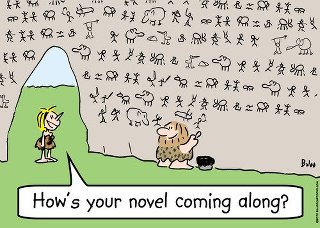
So you think you'll write a book. Okay. It's a good aspiration. I have but one modest suggestion at the outset: Be sure that's what you really want to do, as writing that book can be bad for your health--physically and emotionally--if you're not ready or willing to do what it takes.

What does it take? From my viewpoint, it takes the perseverance of a marathon runner, the patience of a saint and the perspective of an octogenarian at least.

First, let's get an idea. You know, that new slant, brilliant twist, blockbuster worthy, light bulb busting aha?
Now comes the research. Let's see if your topic's been done before. No? Great! Let's get on with the real research. Get those stats correct. Be sure the geography is right. Don't make a mistake with history, for heaven's sake.

 : Closeup portrait of a latin businesswoman thinking while sitting at desk isolated on white background Stock PhotoGot all that in place? Fantastic! Now it's time to wait for your muse to visit. Did I mention, wait? Oh, yes. This is a being that delights in calling the shots, usually later rather than sooner. But finally, she's come calling to accompany you through the morass of story building.

You settle in for a lovely literary liaison with her. And things go so well! That first draft of your manuscript is finished. You are so proud. So happy. So fulfilled.

Then it's time to visit your critique group. Didn't I mention your critique group? Silly me. You must have one. No, no, no to writing in a vacuum. But not to worry. You have produced a masterpiece, and everyone there will sing your praises and cast literary lilies at your feet.

Yeah. Right. They tear it to shreds. Nothing left but your title, and half of them hated that. They say things like, "What point of view? You don't have a point of view." Or perhaps, "These characters are so shallow, I can see right through them." You know. Helpful comments.

Home you slog in a huff, manuscript still too hot to handle from all the vitriol spewed upon it.
Next morning, you take up your quill, open the hateful pages with your fellow authors' marks covering them--and learn! What do you know? Huh. Their ideas aren't half bad. And you summon your muse back and begin again.

Now emerges the fun part. What is it, you ask? Two words, with an article between: Agent or publisher. Research revisited. Yep. You must see who matches whom, as in: "Why did this agent reject my book? Yes, she's known for Romance Novels, but surely she cannot resist my concept book." Have another think about that...

But, hey, miracles still happen (think George Bailey), and a publisher wants your book. That's terrific. You're going to make millions and fast, too. Why, it'll only take--how long? Two years! I could be dead by then. What's that? It'll be published posthumously? Swell.


And so it goes. But, then again there's something wondrous, delicious, stupendous about writing that manuscript, polishing that manuscript, shining that manuscript that I would not miss for the world.

Wednesday, March 6, 2013

Write Only About What You Know? Not So Fast!

Yes, yes, I've heard that axiom before, usually from people who can't get away from safe advice.  It can be shortsighted if one adheres to such a regimen throughout a whole writing career.


I can see where, as a new author, it makes sense to take that truism to heart.  After all, the story we are going to tell is safe, predictable and keeps us within our comfort zone.  I've been there myself.  But after that first manuscript becomes a book, it's time to stretch and reach out of that pattern of coziness and reach for the stars.

So how does one go about becoming authentic and delivering a "you had to be there" or you had to experience that?"  Research.  And more research.  It is important to use, if possible, primary sources as well as sources from different points of view.  A good thing can happen from that.

Something new and exciting may swirl around in your brain.  New possibilities.  New characters.  New roads.  And new journeys.  When that happens, magic occurs. We learn to have faith in our characters and to enter their worlds, well and truly enter.  It becomes one of those "you must have experienced it" moments for an author to hear from a fan.

And what can come from all this newness?  Self-knowledge, truth, a deeper delving into the human condition.  And a clearer understanding of ourselves.  After all, when we write, part comes from our souls, our experience, our psyche. 

Does that then mean we are back to writing about what we know?  Part of it, certainly, as we are a sum of our infinite parts.  But it's the journey, a studied journey, an educated journey born of solid research coupled with that indefinable kernel of originality within all of us.   

Happy researching.  And writing.  And discovering as you go.

Monday, April 23, 2012

U is for Utopia (for Writers)


I was at a writers conferencre this past Saturday.  Several of us were talking about how we began our day of writing.  It started me thinking about what's the very best way for me to begin a productive day, and why it is so beneficial.  So what makes a Utopian writing day for me?

The first thing is an early morning.  I need to be at my computer, coffee in hand no later than 6:15.  I love it.  Still dark. The city lights of Tampa continue to wink at me as they did the night before. Everything quiet except my coffee maker finishing its sputtering from producing the delectable brew.

Ah, the computer awaits.  Again, quiet in my sun room.  Jeeves, my cat, has been fed and sits on my computer ready to be part of Utopia.  I move him to my side in the hopes he'll stay awhile before insisting my lap is more comfortable.

On to email, facebook and blog stats for just a little while.  Need to get to serious work.  Sometimes, if Utopia is in full swing, I don't notice it's become light outside, and inside lamps need darkening.

As the day progresses, my manuscript takes such good form.  Everything simply falls into place.  No words that won't come.  No block.  No realizing I must go back and rewrite this or that.  Yep. Utopia in action.

By the time late afternoon sneaks up, I've happily finished a large section of my latest manuscript, I've marketed my latest book with great success, and I've been asked to conduct an intensive for a large conference.  (Remember, it's my Utopia.)

What's yours? 

Wednesday, April 18, 2012

Q is for Query

Ah, yes, query.  A word that strikes terror into the hearts of many a writer.  And with some reason, I will admit.  That short (and it should be short) letter to an agent or editor can make or break the professional life of an author. After all, this is the first impression you will make with that person who could sell your book.  And, to make matters more complicated, that person will spend about ten seconds on your letter.

How then, do we navigate the treacherous waters of querying?  There are so many answers to this question, but I'll give my readers a few tips if I may.

The letter must be short, never longer than a page. It has to be letter perfect in every way.  Again, this is the first impression the agent or editor has about you, and you certainly do not want to be the last!  This paragraph contains your "jacket flap" material.  You don't want to give away all the twists and turns, but you want to entice the person as you would a potential reader of the book.

After the synopsis, the next paragraph deals with the word count, genre and that all important ego boosting.  Tell, in one sentence, why your book would fit in his or her agency or publishing house.  A little ego stroking is a good thing.  Agents and editors are people, too!

Reading the book with a magnifying glassAnd speaking of ego, the next sentence is about you and your writing platform.  Give any information that pertains to your writing children's books.  If you're published, place those credits here.  List any organizations to which you belong, including the all-important SCBWI.  If you've attended any major conferences, list them.  If you've presented at any conferences, list them.  If you're in a critique group, mention it.  You get the idea.  If you haven't been published, skip this paragraph.  Everyone has to start somewhere!

Finally, thank the agent or editor for his or her time.  Tell them you look forward to their response.  (Many times today, you won't get a response unless s/he is interested.)

Obviously, there is much more to a successful query than in this short post.  Do your homework, research the agency or house, learn which people deal with your genre and practice writing your query.  Make it shine, then polish it some more.  Remember, this may be your only chance at the golden ring.  Make sure you prepare yourself for a good grab!