Showing posts with label Publisher's Weekly. Show all posts

Friday, May 20, 2016

What do Librarians Want to See in Middle Grade Books?

 
What is the wish list for middle grade books at this time?  Two librarians discuss their wants and needs, and it is interesting and a bit surprising as well.
 
Jennifer Hubert Swan is the director of library services at Little Red School House and Elisabeth Irwin High School in Manhattan. She served on the 2006 Michael L. Printz Award Committee and chaired the 2012 YALSA Award for Excellence in Nonfiction for Young Adults committee. She also teaches young adult literature and youth library programming in Pratt Institute’s School of Information and writes about books for teens on Reading Rants, her blog.
 
Katie Richert is the assistant head of youth services at the Bloomingdale Public Library in a Chicago suburb. She is a member of the 2017 Michael L. Printz Award Committee. When she isn’t reading books for committee work, she says, she is “storytiming” it up with preschoolers around town.
 
Richert:  "I’d like publishers to know that the kids love a series, but a great standalone can still have the same impact on a reader....I was surprised by the love that Roller Girl [by Victoria Jameson] has gotten. I cannot keep that on the shelf! That one book has lead to great discussions with both boys and girls, more interest in our graphic novels, and more interest in Roller Derby—yes, Roller Derby!'
 
"I, too, have loved how books are now featuring diversity and different sexual orientations in all genres. I think that is showing how much these things affect kids and teens and need to be part of every story. I also have liked that there have been more books focusing on mental illness. It was something that might have been taboo before to talk about, but it affects a lot of people. I like how there are both books describing living with mental illness and also living with a family member facing this same issue. I think showcasing this in young adult or middle grade literature is bringing it out for discussion. That could mean a world of difference to a teen facing mental illness or dealing with mental illness at home."
 
Swan: "While on the topic of diversity in general, it would be so nice to see some middle-grade and YA fiction that included characters grappling with issues of spirituality, especially Christianity. While we see titles where teens are exploring their Jewish (Never Mind the Goldbergs; Nick and Norah’s Infinite Playlist) or Muslim (Does My Head Look Big in This?; I Love I Hate I Miss My Sister) culture or roots, very rarely is Christianity discussed in a mainstream, secular way in popular fiction."
 
"And on a lighter note, more smart, humorous books for the middle school set (A Tale Dark and Grimm and The Schwa Was Here are my go-to book-talk choices for middle schoolers and I could hand-sell a library-full of more titles like those) and more YA gross-out, laugh-out-loud books like Don Calame’s Swim the Fly series. Every year I win the respect of an eighth-grade boy when I recommend those books to him. There is no bodily function that Calame is afraid to write about, which makes for some hilariously horrifying situations that seem to be especially appreciated by eighth-grade boys."

Sunday, November 8, 2015

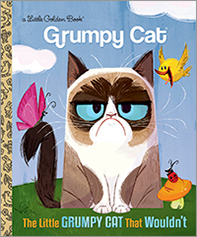
A New Golden Book-Grumpy Cat!


Random House Children’s Books has acquired the rights to the Internet meme Grumpy Cat for a series of three Golden Books. The first title, The Little Grumpy Cat That Wouldn’t, is scheduled for publication on July 26, 2016.

“The deal came together so quickly,” says Chris Angelilli, v-p, editor-in-chief, and director of license publishing, who is overseeing the program. “The acquiring editor, Christy Webster, is a huge Grumpy Cat fan. She reached out to Grumpy Cat’s agent, and he said ‘yes’ right away. He didn’t even have to think about it.” The deal was met with enthusiasm throughout the company, he adds, where many employees have Grumpy Cat calendars or captioned cartoons at their desks.

“Christy is such a huge fan and lives and breathes Grumpy Cat, so the story came together naturally,” Angelilli continues. “And the illustrator, Stephanie Laberis, who had been working on some original non-licensed Golden Books for us, accepted the job before she even heard the payment or the deadline. She loves Grumpy Cat.”

The frowning kitty, whose official and fan-generated images on social media are accompanied by captions such as “Good morning... No such thing” and “I purred once… It was awful,” has accrued eight million Facebook followers over the past three years and inspired an array of licensed merchandise ranging from swimsuits to Grumpuccino-brand coffee. Ongoing Grumpy Cat publishing includes titles such as Grumpy Cat: A Grumpy Book and The Grumpy Guide to Life from Chronicle Books; Dynamite Entertainment’s comics; and coloring, sticker, and paper doll formats from Dover Publications.

Sunday, August 24, 2014

Richard Scarry’s Best Lowly Worm Book Ever! is Making Its Entrance

According to Publisher's Weekly and Sally Lodge, Richard Scarry’s Best Lowly Worm Book Ever!, a never-before-published book starring this Tyrolean hat-sporting character, will be released by Random House on August 26. 

The author’s son, Richard (Huck) Scarry Jr., discovered the manuscript and sketches for Best Lowly Worm Book Ever! in his father’s studio in Switzerland several years ago. Huck, an author and artist in his own right, decided to complete and color the illustrations for the book, which, true to Richard Scarry tradition, playfully introduces childhood words and concepts.

Photo:  Marco Pasini
The studio search was prompted by Neil Dunnicliffe, Huck Scarry’s editor at HarperCollins U.K., who asked him if he was aware of any sketches that his father, who died in 1994, may have done for any unpublished books. “I agreed to have a look around his studio, and in no time I came across a large, gray cardboard portfolio leaning against one of the legs to his drawing table,” he explained. “There were quite a number of sketches inside, but little that would be ready to bring forward as a book, with one exception: a book about Lowly, with all the texts typewritten and taped in place with rough, thumbnail sketches of the layout. The book looked pretty complete.”
Emulating my father’s style, and above all his sense of humor, is always a challenge for me, but I think I got it pretty right this time.

Mallory Loehr welcomed the new Lowly Worm adventure to the house’s ongoing Richard Scarry publishing program. “The rebranding of Richard Scarry’s beloved backlist titles has been a huge undertaking and we are so pleased with the outcome,” she said. “This new Richard Scarry title is an even bigger reason to celebrate, and that it is about Lowly Worm, one of the iconic Scarry characters, makes the celebration that much more exciting.”

Saturday, September 15, 2012

New Study: 55% of YA Books Bought by Adults

Here is an interesting and important new post found at Publishers Weekly concerning adults who are reading Young Adult books--a first!


According to a new study, fully 55% of buyers of works that publishers designate for kids aged 12 to 17 -- known as YA books -- are 18 or older, with the largest segment aged 30 to 44.  Accounting for 28% of sales, these adults aren’t just purchasing for others -- when asked about the intended recipient, they report that 78% of the time they are purchasing books for their own reading. The insights are courtesy of Understanding the Children’s Book Consumer in the Digital Age, an ongoing biannual study from Bowker Market Research that explores the changing nature of publishing for kids.

“The investigation into who is reading YA books began when we noticed a disparity between the number of YA e-books being purchased and the relatively low number of kids who claim to read e-books,” said Kelly Gallagher, v-p of Bowker Market Research. “The extent and age breakout of adult consumers of these works was surprising. And while the trend is influenced to some extent by the popularity of The Hunger Games, our data shows it’s a much larger phenomenon than readership of this single series.”
 
Indeed, 30% of respondents reported they were reading works in the Hunger Games series. But the remaining 70% of readers reported a vast variety of titles (over 220), only two of which commanded more than five percent of overall sales – Harry Potter and the Deathly Hallows and Breaking Dawn.

“Although bestsellers lead, there’s a long tail of rich reading that has interesting implications for the publishers of YA books in terms of discovery and consumer relationships,” said project editor Kristen McLean.

The trend is good news for publishers, as these adult consumers of YA books are among the most coveted demographic of book consumers overall. Additional insights from the Bowker study show these readers are:
    Early adopters: More than 40% read e-books, equivalent to the highest adoption rates of adult genres of mystery and romance
  • Committed: 71% say that if an e-book of their desired title was unavailable, they would buy the print book instead
  • Loyal: Enjoying the author's previous books has a moderate or major influence over the book choice for more than two-thirds of the respondents
  • Socially active: Although more than half of respondents reported having "no interest" in participating in a reading group, these readers are very active in social networks and often get recommendations from friends.
Understanding the Children’s Book Consumer in the Digital Age is sponsored in the U.S. by Little Brown for Young Readers, Random House, HarperCollins, Scholastic, Disney, Penguin, DK, and Macmillan. To order a copy, contact Bowker Market Research at MarketResearch@bowker.com.

Wednesday, September 5, 2012

Olivia and the Fairy Princesses by Ian Falconer

Everyone knows, and I daresay, loves Olivia the Piglet for her headstrong and opinionated manner.  She is certainly a character who lives large!  I am delighted to share this interview with author Ian Falconer conducted by Nathalie op de Beeck.

Why did you choose to take on the pink princess crowd in this new picture book?

I live in the Village in New York City, and it has become radically gentrified in the last 15 years. All of these little girls walk around with their wands and their tutus. There are squads of them roving the streets. And Olivia would want none of that.

The story came out of working with my sister, who is also my assistant, and doing the marketing. We oversee as best we can the kind of toys they produce. We kept running into this problem – they all wanted to do pink, pink, pink. I had to say, “No, no, everybody’s doing pink! How many pink tutus can you sell?” Marketing people just want to stick to something safe, I guess.

On the book’s pale-rose-and-aqua-green cover, you picture Olivia wearing that very tutu, holding a wand, and grimacing at herself in a hand mirror. On the reverse, she casts them aside. How does this image clash with our expectations of Olivia, who usually wears a daring red?
 Pink doesn’t make sense with Olivia because she is not that kind of creature anyway. In the first book she does a little ballet thing, but it’s not really her character. So the book emerged from my frustration with trying to get some good quality stories and dolls and outfits and things that reflected Olivia more than the standard tutu.

Are you at all nervous about how pink devotees will respond to Olivia’s rejection of such accoutrements?


I started the book about a year ago, and I had some doubts. But then I saw a viral video of a little girl filmed by her father in a store, in the pink aisle with all the girl stuff. She goes on a rant and says, “Why do boys get all these different things? We all have to get pink!” That made me feel very happy. I thought it was pretty spontaneous, or at least articulate enough to be non scripted.

As you wrote this manuscript, did you run into any controversy with editors around Olivia identifying “some of the boys” as wanting to be princesses as well, not unlike the child in My Princess Boy?
No, no one said a word about that. Either they didn’t dare or it’s simply a non-issue now. The line just sort of came out (no pun intended) and I thought it was funny.

Olivia wears basic black, models non-Western princess garb, and stands apart from the throng. Does her confidence represent your wish that children resist conformism?

I don’t mean to offend anybody, but it’s a way of asserting Olivia’s independence. There are no mean girls in this book. There’s no rival here. It’s just Olivia’s observation. There are alternatives.

Plus, a lot of things that happen to Olivia are largely in her mind, so I’d take it with a grain of salt. The Halloween scene [where Olivia dresses as a warthog and terrifies party-going princesses] probably would never happen that way in real life. They wouldn’t be running away in fear. But in her mind, she thinks so.
 

Have you read this book to child audiences yet, or thought about how it might be performed?
 No, I’ve just had the book a couple weeks, and I am terrible at readings and speaking in public. Children are a devastatingly critical audience. That said, this book particularly would be a good play.

If Olivia shuns fairy princesses, how do you account for the fact that she loves accessorizing and putting on lipstick, as she famously does in Olivia Forms a Band?

My editors just hated that – they thought that it was grotesque and none of the kids would like it. So my sister took it to school where my nephews went, and read the story to them, and they just thought it was the funniest thing in the world. I never underestimate children: they’re built to sort things out, figure things out, make sense of things.

Rather than fantasize about fairy magic, Olivia finds a heroine in Martha Graham. Your book dedication is a tongue-in-cheek apology to Ms. Graham, and you picture Olivia in a series of dramatic modern-dance poses. What gave you the idea for this comparison?

At first as I was drawing for the book, I had her in a black leotard doing angular dancing. And I thought, oh, that would be funny. But nobody will care, nobody will get the Martha Graham reference, and certainly no kid will. But it’s so funny, the two pages devoted to her dancing like Graham, that I had to do it.

Do you write and draw in the expectation that an adult will tell a child about Martha Graham or define the multi-syllabic words – like the moment where Olivia considers a career in journalism to “expose corporate malfeasance”?

That’s what I count on a lot, that children read with a parent who will explain what “corporate malfeasance” means. In my experience as a kid, we all loved big words. There’s a point in every kid’s life where they learn the word “immature” and start using it – “Oh, she’s so immature!” – without really understanding what it means. They like the sound of big words.

How does your creative work for young audiences overlap with the kind of satirical and edgy illustration you do for periodicals like the New York Times Book Review and the New Yorker?
Well, apart from the similarity of drawing techniques, I put myself in the mindset for the task at hand. I try to think with the fairly direct logic of a child for Olivia, and then with the topsy-turvy logic of, say, a New Yorker cover. It’s a bit like doing crossword puzzles—you get out of practice if you don't do them, but if you do them regularly, you begin to think that way.

Might you someday create a picture book that does not feature Olivia, or do you find most of your picture book inspiration in her?

Olivia is based on my niece, and my other sister has twin boys, so she’s always been jealous that Olivia got all this attention. So I thought, I’ll write an adventure story. I’m actually working on another book right now about two dachshunds, two boys.

Your niece Olivia famously has signed books and enjoyed being the model for your character. How does the “real” Olivia feel about pink these days?

I asked Olivia (who is a sophomore in college now, by the way), and she said, “Well, it depends on the occasion!”

Saturday, August 11, 2012

Boxcar Children Mysteries Prequel Written by Patricia MacLachlan

Seventy years after its debut, the Boxcar Children series is  getting a prequel, written by Newbery Medalist, Patricia MacLachlan.

 In The Boxcar Children Beginning: The Aldens of Fair Meadow Farm, Patricia MacLachlan, author of Sarah Plain and Tall, provides what she calls “the beginning before the beginning."  Gertrude Chandler Warner wrote the series about four siblings who live alone in a railroad car in the woods.

According to Publisher's Weekly, the book will be available on September 1 from Albert Whitman.  It will give a backstory to the series, which debuted in 1942 and has grown to more than 150 titles across a variety of formats, including beginning readers, graphic novels, and special editions.

Warner  thought up the plot of the original novel one day while she was home sick from her teaching job.  Since then the Boxcar Children Mysteries has more than 50 million copies in print worldwide.

Patricia MacLachlan
Photo:  John MacLachlan

Senior editor, Wendy McClure, has been at the
editorial helm of the series for the past decade; she explains that the prequel was sparked in part by letters that the publisher has received from readers over the years. “There are a couple of questions that readers always ask,” she says. “One of them is, ‘What happened to the parents?’ We realized that there was a story there and decided that it was time it was told.”
 
MacLachlan was an easy choice, according to McClure:


We knew from the start she’d be perfect. She writes so beautifully about families and about families coming together in unusual ways. She had great insight into the young characters.

When approached, MacLachlan says, she willingly took on the task. “A door opened and I decided to walk through it and see how it goes,” she says. “I like these children a great deal, which made it easier to write about them.” MacLachlan says that she did find the prospect of writing a prequel a bit daunting, but it provided her with some boundaries, too. “I did invent the parents, but in a sense I knew what kind of parents they had been, because of who their children are. The siblings are thoughtful and kind, and they take care of each other.”

Patricia MacLachlan and Nancy Stewart
IL Reading Council Conference (2012)
In preparation for writing The Boxcar Children Beginning, MacLachlan read a number of the series’ installments – and listened to her son read them to her six-year-old granddaughter. “I sat on the edge of her bed as he read the books, and I was able to hear her reaction to them,” she says. “This helped draw me into the lives of these characters. ”

The author also drew from her own grandparents to create the prequel, in which the Aldens share their farmhouse with another family that has lost its home in the Depression. “My grandparents took in a lot of people who had lost their jobs during [that time],” she says. “So I was able to use their lives as well."

Though she has finished the novel, MacLachlan says the Alden children haven’t entirely disappeared from her life. “I sometimes dream of them going back to the farm,” she says. “I’m not exactly sure where that comes from. I guess they have in a sense become part of my family.”

Tuesday, July 5, 2011

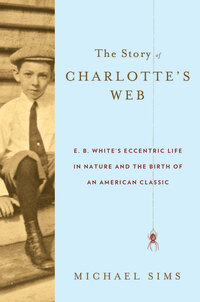
The Story of Charlotte's Web

One early fall morning in 1949, E.B. White walked into the barn of his farm in Maine and saw a spider web.  Then on a cold October evening, he noticed that the spider was spinning an egg sac.

The Story of Charlotte's Web, by Michael SimsWhite never saw the spider again.  When he had to return later that fall to New York City to his job as a regular contributor to The New Yorker magazine, White took out a razor blade and cut the egg sac out of the web. He put the sac in an empty candy box, punched some air holes in it, put the box on his bedroom bureau in New York and promptly forgot about it.

Weeks later, tiny spiders were everywhere, escaping through the air holes. White thought this was wonderful until the cleaning lady complained about the hundreds of spider webs everywhere!

Now comes a book about the real E.B. White and every one's favorite spider, Charlotte.  Michael Sims, author of The Story of Charlotte's Web, weaves a yarn of interest about the author of the best children's book ever published in the US.  This is according to a poll of librarians, teachers, publishers and authors in the trade magazine, Publisher's Weekly.

As a very old man with Alzheimer's, White liked to have his books and essays read to him. When his son, Joe, obliged, White would ask who who wrote them.  "You did, Dad," Joe answered.  White would think about this for a moment and say, 'Not bad."

CharlotteWeb.png