Showing posts with label author. Show all posts

Monday, June 5, 2017

Dear Reader, Love, Author Blog Post

I have posted my letter to the Dear Reader, Love, Author Blog.  Hope you enjoy it!
 
Dear Reader, 
 
Have you ever walked along a beach somewhere on this glorious planet and found instant inspiration, an epiphany of sorts?  Well, that is exactly what happened to me one glorious December day seven years ago on Clearwater Beach, Florida.  Right out of the blue, as it were.  Here’s what happened:  Strolling along on wet sand, I came across the outline of a heart.  But what was written inside stopped mine. Only one word. Bella. It became completely clear that I write a book about a beach girl called Bella. And from that bolt of insight, Bella was born.
 
As sometimes happens, an almost simultaneous incident occurred; this time a terrible one: The Deepwater Horizon oil spill in the Gulf of Mexico on April 20, 2010. The entire world was inundated with wrenching photos of once blue water slicked over by deadly oil, birds drenched and weighted down with the deadly stuff, and BP executives spewing invectives about how it was not their fault. And something snapped in me.  I sat down and wrote One Pelican at a Time: A Story of the Gulf Oil Spill.  Not only was Bella the protagonist.  Her best friend Britt joined her in the effort.  And that book began the Bella and Britt beach series. 
 
My newest offering, Mystery at Manatee Key, is the fourth in the series and features Britt front and center.  It is she alone who must rescue Bella and the ranger from a ring of manatee smugglers.  By now, the series reader is familiar with the ranger, who is warm-hearted and loves all things beachy.  Dwayne Smarr is the bad guy and Britt’s nemesis throughout much of the book.  He is so bad that he’s fun to love to hate.  With kids, black and white rules, and Dwayne has no shades of gray!
 
Throughout the series, I have tried to infuse a love of and respect for nature and Mother Earth, the only home we humans have at this point in our galaxy.  Without being preachy, it is my hope that in reading the books, children will find a fun story, interesting facts, and a love of learning interwoven throughout the pages.  If all that occurs, I’ve been a successful author and have done my intended job.

Friday, May 1, 2015

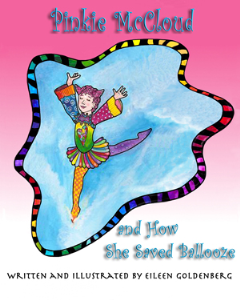
Pinkie McCloud and How She Saved Ballooze by Eileen Goldenberg


Eileen Goldenberg has done it again!  This time she has written and illustrated a gorgeously rich and textured children's book, Pinkie McCloud and How She Saved Ballooze.  A confection of poetry, pictures, and prose, Pinkie's story reads like an allegory that kids will understand and love.

Pinkie McCloud and How She Saved Ballooze | eBooks | Children's eBooksPinkie is a happy girl who happens to have been born a wingbling, a rarity in the land of New Skyland.  Not only that, Pinkie has pink wings, a double rarity!  In her land, everyone is happy, and contented, and good.  Wingblings especially, are kindhearted, and willing, and able to help others.

Alas, Pinkie is told the grim news that the family must move far away to a place called Balloze.  There are no wingblings in this place, and others make fun of Pinkie and consider her a freak.


Eileen's Pinkie Doll
When, however, an evil storm rages through Ballooze, the residents think all is lost.  The only one who doesn't is Pinkie.  She knows what to do. She does it and saves not only the day but the entire town!

Kids and their caregiver readers will love the luscious book, illustrated throughout in rich colors--until the storm appears.  With Eileen's dark and ominous illustrations, one can feel--almost taste--the danger at hand.

This is a book that can be read again and again.  The illustrations call for repetition to be sure one captures every aspect of the  fine artwork.

This blogger would urge you adult readers to acquire this idyll of a book not only for your children, but for your selves as well!

Eileen Goldenberg has been a working artist in the Tampa area for over thirty years. Her paintings and other works are widely collected here and elsewhere.  Her paintings on canvas and board have been commissioned by individuals and organizations and have graced book and magazine covers.

Pinkie McCloud can be purchased through the publisher, Guardian Angel Publishing as well as through Amazon and Barnes and Nobel.com.

Eileen's art can be found at:  http://fineartamerica.com/profiles/eileen-goldenberg.html

Eileen will sign her new book, Pinkie McCloud and How She Saved Ballooze on Monday, May 9 at 4PM at Inkwood Books, 
216 S Armenia Ave
33609-3310 Tampa

Wednesday, April 8, 2015

Rainbow of Friendship: Wonderful New Children's Book by Joni Klein-Higger

It is always such a great pleasure to feature the books of people I know and admire on this blog. So it is with Joni Klein-Higger, the author of the lovely new kids' book, Rainbow of Friendship, published by Guardian Angel Publishing. 

My next blog will feature Rainbow's illustrator, Eileen Goldenberg.
You are a musician and an author, Joni.  How did the two come about, and when did they fuse?

As a girl I was always making up songs and continued doing so throughout my life. Being a children’s book author, however, was much more of a challenge. Unlike songwriting, which came naturally to me, the children’s writing bug “bit me” later in life. It started when I was a Co Girl Scout Troop Leader for my daughter’s troop. Each Girl Scout had to create a book to earn a Literature Badge. We ordered a set of blank books by the dozen. Ten Girl Scouts, twelve books, two Troop Leaders.  The stage was set, and my first book, Rainbow of Friendship, catapulted into motion. That was over fourteen years ago. Needless to say, I’ve done quite a bit of writing and revision since its inception.
 
 Where did you get the idea for Rainbow of Friendship?

When I received my "blank” book at our Girl Scout gathering, I needed to think of an idea, and fast. I looked around at our beautiful troop of girls, each with unique physical and personality traits; each adding their individual gifts to the group as a whole. I found my story.

 Do you think your love of rhyming books come from the musical side of you?  Tell us a bit about that, please. 

Yes, a good rhyming book is very much like a song. Though, I must confess, I often struggle with meter when writing rhyming books – with songwriting, a melody can be stretched to fit my lyric/rhyme. Much to my critique group’s dismay, (“You should try it in prose, Joni!"), I love the fun words, rhymes and rhythms of rhyming picture books and can’t get enough of writing them.

 What’s in store next for your readers?

       Later this year Guardian Angel Publishing will be releasing a picture book I co-wrote with Dr. Flora Zaken-Greenberg, Ph.D. entitled, I HAVE A VOICE. It is the story of a girl who is afraid to speak; with the help of a “feelings doctor”, she discovers ways to overcome her problem. This book is being illustrated, as well, by Eileen Goldenberg (Yay!). Guardian Angel Publishing will also be releasing RED, a children’s musical I co-wrote with Jane Tesh.

And speaking of readers, where socially can they find you?

First, Nancy, I want to thank you for interviewing Eileen and me today. I’m a big fan of yours and am honored to be a part of your blog.  Readers, you can find me at my website, www.joniworld.com, or on Facebook at my Joni Klein-Higger Music and Joni Klein-Higger Author pages.  Please stop by and say, “hi!”

Monday, June 30, 2014

You Have a Great Idea for a Middle Grade or Young Adult Book? Now What Do You Do?

So you have a wonderful idea for a book.  How can you turn that fabulous idea into a great book?  And how do other authors do it?  

Certainly middle grade novels require a bit of amping down, but with young adult, all bets are off.  You can create the creepiest, meanest, or most selfless and heroic characters you want without fear of doing so.  In fact, young adult novels have become known as “crossovers,” appropriate for teens and adults alike!

Let’s start with characters—protagonists and antagonists.  Immediately move them out of the ordinary but not too slant.  By that I mean, keep them a little bit “everyman” while making them non-ordinary.  Most of us write characters with whom we can identify—those within our comfort zone.  Get rid of that notion.  Try writing about the hapless, the flawed, those who are different than you but, of course, are still human with many of the same desires and wishes.  Hard to do?  Yes, but so worthwhile in creating a complex and memorable character.  (Think Tennessee Williams, Ernest Hemingway, Margaret Atwood.) In The Handmaid’s Tale, Atwood gives the Cinderella protagonist no quarter—and no handsome prince to save the day.  She’s on her own, and the readers love it!


Have your characters do—not describe, or talk the reader to death, or kill them with boredom.  In other words (and I hate to say it again but will) show, don’t tell.  Let the people you’ve brought to life on the page live, betray, love, and hate—all the time showing what they do instead of describing how they do it.

Think of gestures you or others do.  Things we’re not really aware of many times on a conscious level. A look, a non-look when one should occur, a gesture, a speech hesitation, too much speech, a realization that one knows s/he has said too much, and s/he knows you (and perhaps the whole table) knows…I could go on forever.  These human markers drive fiction, they drive the story, heck—they drive life!  Use them to your advantage.  But remember, don’t describe them, make your characters live them.


If we (and I place myself first here) can infuse our writing with such techniques, our stories will improve. They will stand out.  They will shine. They will be art imitating life.  And who knows?  They may be as true to life as life itself.

Sunday, June 1, 2014

Writing: One Way into a Child’s Heart


An author of children’s books needs to be in tune with kids’ needs and emotions. How does one do that?

The most important answer to the question lies within one’s own heart.  We must know right from wrong, basic values children need and positive role modeling to name but a few.  Only when we are quite convinced all this is well and truly in place within us, can we dare to instruct, gently and judiciously, through our stories.

We need to know children.  Their hopes. Their dreams.  Their fears.  Their frustrations.  If we are going to address their inner most psyches with our words, we must be careful to honor those feelings and to never belittle or minimize them.  We have to be true to the children we are trying to reach.

Now, this does not have to be carried out as a sad, slow-moving dirge; indeed, quite the opposite. Embedded in our sweet, scary, interesting, adventurous or belly-laugh books should be nuggets of human truth. The same notion that good teachers call implicit curriculum. Live it. Model it. Be it. 

But can we as authors really achieve finding the absolute truth, and courage to write about it?  Carefully, thoughtfully, sensitively, humanely, we can guide our young readers.  If we are successful, we leave the child better for having read our book. We hope s/he has grown and, in a way, has matured because of us.  What else can we ask for as an author?

Monday, February 3, 2014

What in the World do You Authors Do All Day?


I am asked this question more times that one could imagine.  For those of us who write full-time, the answer is simple and complex:  We work all day long!

My day has become, by fiat really, divided into three segments.  The first begins about 6:15 in the morning. Still dark.  House quiet.  Coffee brewing.  Puppy ready to jump into my lap for a hard day’s writing.

My attention turns to housekeeping issues.  Emails from two accounts, facebook, Twitter, Google Circles and my blog. Several years ago, none of this existed for me but email.  Today social networking has big teeth and is crucial to an author’s professional life.  If I’m lucky and efficient, all this can be finished by around 8 AM—unless it’s a gym day, when things get pushed back by an hour.

The second segment of time focuses on actual writing.  I am best at “being an author” if I've warmed up with other tasks but am not too tired.  This is when being in the flow occurs.  When nothing is in my mind but the story at hand.  When I am squarely in my protagonist’s (or antagonist’s) head.  When nothing else matters but moving the story from here to there.  What a good time of day it is when the magic works.  Sometimes it doesn’t.  Mercifully, most of the time it does.

The third part of my professional day is decidedly not my favorite, and sometimes I skip it.  That would be marketing.  There was a time not long ago when authors didn’t have to do such things.  Not anymore!  Today one must talk with bookstores, visit schools (which actually I love), do signings at various locales (fun, too, come to think of it).  Hmm.  Maybe I dislike the idea more than doing it…

The evenings will find me with my laptop in front of the TV, which I usually zone out.  It’s then that I’ll be sure my next blog is ready to post later that evening, my calendar is up to date and coffee’s ready to brew.  Everything at the ready for 6:15, quiet, coffee, puppy…You get the drift.

I can be brought out of the flow at:


Web Site:  http://www.nancystewartbooks.com 
Blog Site:  
http://www.nancystewartbooks.blogspot.com
 Twitter:   
 https://twitter.com/#!/stewartnancy                                                                                          Facebook: 
https://www.facebook.com/nancy.rosenthalstewart

Thursday, January 30, 2014

So You Think You'll Write a Book?

So you think you'll write a book. Okay. It's a good aspiration. I have but one modest suggestion at the outset: Be sure that's what you really want to do, as writing that book can be bad for your health--physically and emotionally--if you're not ready or willing to do what it takes.

What does it take? From my viewpoint, it takes the perseverance of a marathon runner, the patience of a saint and the perspective of an octogenarian at least.

First, let's get an idea. You know, that new slant, brilliant twist, blockbuster worthy, light bulb busting aha?
Now comes the research. Let's see if your topic's been done before. No? Great! Let's get on with the real research. Get those stats correct. Be sure the geography is right. Don't make a mistake with history, for heaven's sake.

 : Closeup portrait of a latin businesswoman thinking while sitting at desk isolated on white background Stock PhotoGot all that in place? Fantastic! Now it's time to wait for your muse to visit. Did I mention, wait? Oh, yes. This is a being that delights in calling the shots, usually later rather than sooner. But finally, she's come calling to accompany you through the morass of story building.

You settle in for a lovely literary liaison with her. And things go so well! That first draft of your manuscript is finished. You are so proud. So happy. So fulfilled.

Then it's time to visit your critique group. Didn't I mention your critique group? Silly me. You must have one. No, no, no to writing in a vacuum. But not to worry. You have produced a masterpiece, and everyone there will sing your praises and cast literary lilies at your feet.

Yeah. Right. They tear it to shreds. Nothing left but your title, and half of them hated that. They say things like, "What point of view? You don't have a point of view." Or perhaps, "These characters are so shallow, I can see right through them." You know. Helpful comments.

Home you slog in a huff, manuscript still too hot to handle from all the vitriol spewed upon it.
Next morning, you take up your quill, open the hateful pages with your fellow authors' marks covering them--and learn! What do you know? Huh. Their ideas aren't half bad. And you summon your muse back and begin again.

Now emerges the fun part. What is it, you ask? Two words, with an article between: Agent or publisher. Research revisited. Yep. You must see who matches whom, as in: "Why did this agent reject my book? Yes, she's known for Romance Novels, but surely she cannot resist my concept book." Have another think about that...

But, hey, miracles still happen (think George Bailey), and a publisher wants your book. That's terrific. You're going to make millions and fast, too. Why, it'll only take--how long? Two years! I could be dead by then. What's that? It'll be published posthumously? Swell.


And so it goes. But, then again there's something wondrous, delicious, stupendous about writing that manuscript, polishing that manuscript, shining that manuscript that I would not miss for the world.

Sunday, December 8, 2013

Tried and True Tips on a Writing Routine

Most of us who are not just fond of, but are compelled to put pen to paper (virtual, or otherwise), find a routine of sorts that works.  Below are a few tip from what I require to get the most out of my creative time
.
Write at least two hours a day--
It’s a goal that many of us have, and it’s a worthy one: make writing a part of your daily routine. If you can do more than two hours, that’s wonderful, if you can only do less, that’s okay too. The trick is to write for the same amount of time every single day, and try your best to be consistent about it. 

 Write when you’re in the flow--

It is amazing how much this phenomenon happens with an author. Write when you’re ready to pour whole chapters/stories/volumes out onto the page. And since the flow is rather magical, try not to let much of anything interrupt you.  (Those of you with small children are exempt from this.  I've been there!)


Keep a notebook or put notes on your phone or iPad--
This is a good option for those on the move and for those who write best in short, quick bursts. I constantly text myself ideas and other thoughts about the book I am currently writing.  It is a great help, and I wonder now how I did without such a tool before.

Live the life of the mind as an author--
I find myself dwelling in my head about the latest book I'm writing.  It is so helpful to keep it tucked somewhere close by and dredge it up frequently.  It's amazing how many scenes I've written in my head while driving or taking a walk.  Try it!

Wake up early / Stay up late--
In other words, carve out a quiet time for yourself.  It does wonders for your concentration, and the quiet helps to get sentences, scenes, and chapters to make sense in an orderly fashion.  Early morning  (I'm at my computer at six) is the best time for me.  A cup of coffee steaming next to me on the table, my laptop working away, and I'm in Heaven.


Read, read, read...for ideas, inspiration, and voice---
It is important for me to read other authors' works.  Sometimes, when I cannot find my voice, a quick perusal of a favorite book will do the trick.  Suddenly all is clear, the voice turns to perfection, and you're off and running.

I hope this helped those of you struggling to find the time to practice your craft.  Although it can be difficult, certainly it is not impossible.  Try some of these tips.  Happy writing!

Wednesday, April 10, 2013

Author and Illustrator: The Ultimate Artistic Compliment


We all know on the surface at least, that authors of children's books are only half finished when they complete a story book.  Without the magic dust that illustrators provide, our books are half-baked.

Dixie Phillips

Today it is my pleasure to introduce author, DixiePhillips, and illustrator, K.C. Snider, to my readers.  Both ladies are published by Guardian Angel Publishing. They will answer many of the questions asked of me by those who enjoy a peek into our lives.  I call writing and illustrating the slowest of the performing arts.  After you've heard from these two artists, I think you'll agree!


Please have a look at the trailer for Journey's Promise at the bottom of this post.

We will begin with Dixie and go immediately to much the same question for K.C: 

NS  When did you know you wanted to write for children?


DP   I’ve always had a deep love for the little ones in my life, but I never had any secret aspirations of being a children’s author. My writing evolved from a need in our church.  I am a pastor’s wife and when my husband and I moved our two small children to a rural community in northern Iowa, I knew our new church’s children’s ministries needed some desperate help. I started writing special occasion programs for the children of our congregation. Hearts were stolen as the children ministered through drama and song. People encouraged me to send my ideas to publishers. At first, I was reluctant, but finally submitted some of my ideas.  I discovered there was a real need in other churches for children’s ministry resources, too.


NS  Have you always been interested in illustrating, drawing, etc., K.C.?


K.C. Snider
KC  I was about 10 when I realized how much I liked to draw. I loved Norman Rockwell’s work and tried to emulate his illustrations.  I basically started illustrating stories from Oregon’s School of the Air by OPB where they would read stories over the radio and we were supposed to illustrate s0ome part of the story and send the art in to the OPB teacher.  I used water colors that you could buy in a tin from the grocery store and drawing tablet paper my mother would buy for me.  That’s how I knew this is what I wanted to do and I was good at it.


Eventually, I graduated from the School of Arts in Eugene, Oregon.  I began teaching art classes at Lane Community College in Eugene, Oregon and Linn Benton Community College in Corvallis, Oregon at the same time.  Overall, I taught art for 17 years at these colleges.  After that, I went out on my own as a portrait artist to Western wildlife fine arts.  There is not a medium I have not worked in at one time or another.  I got back into illustrating full-time about 7 years ago around the time fine arts sales began to decline due to the economy.


NS  Where do you get your ideas? (Everyone wants to know this!)


DP  The air is jam-packed full of inspiration if we just take the time to listen. I keep my ears and eyes open to what is happening around me. Stilts the Stork was written after I read a newspaper article about a bird with a nest on a golf course. She sat on a golf ball, thinking it was an egg.   Angel Eyes was written after our little girl asked, “Mommy, what did the angels think when Jesus died on the cross.” I’ve discovered my best ideas come from listening to children’s conversations.   Stubby’s Destiny was written when I met with a little girl who was convinced she had no divine destiny. She felt like she was always at the wrong place at the wrong time.


NS  Where do you get your ideas, K.C.?


KC  I have to read the manuscript, first, to get ideas swirling around in my head.  That is part of the Creative Mind; I give it time, don’t push it and it will come to me.  Sometimes they solidify when I do my research on a particular story on the internet.  For example, I found pictures of storks on the internet and those combined with the poetics of the story and the cartoon to “see” a cartoon stork.  Along with input from friends and co-workers, that is how “Stilts the Stork” was born.


NS   How do you organize your writing day, Dixie?

I am OCD when it comes to writing. You can usually find me with my laptop working on some writing project. I am a songwriter and ghostwriter. I usually write every day. I’ve discovered the only way to become a better writer is to write. I’m also a life-long learner. I enjoy honing my writing craft and growing as a writer.

NS  How do you organize your illustrating day? 
K.C.  I set my own pace and I am very, very diligent about keeping to my schedule.  I work best later at night when it’s quiet.  I sleep in, then start back up with my first cup of coffee in late mornings.  I do not get started until about 10:00 AM.  But I can be caught researching or painting until after 1:00 AM.  My Publisher knows she can call me at midnight, no problem, and she has!  I do take my breaks to stretch and go for walks so my backside doesn’t begin to spread! 

NS  This book seems a bit different from your others, Dixie. Tell us about it, please.


DP  A few years ago, my niece, Christa, and her husband, Muhsin, began their adoption journey. They traveled to Ethiopia and fell in love with a little girl named Journey and her baby brother Maddon. After the siblings came to America and mastered the English language, Journey wrote a story about life in the orphanage and her adoption experience. Christa was moved by Journey’s story and invited me to help Journey develop it and make it a children’s picture book. From the beginning, we realized it was a very special story. I presented it to Lynda Burch at Guardian Angel Publishing and she accepted it right away. Christa and Mushin hope to use their adoption experience as a platform to help other families adopt children needing a home and family to love. They hope to schedule speaking engagements across the United States for Journey to share her experience and new book: Journey’s Promise.


NS  Dixie’s book is so lovely.  How/why did you illustrate the book the way you did.


KC  I wanted the children to look as close to the real children as possible since this is based on a true story.  I drew on my background as a portrait artist to present the characters as they really looked at the time… and today.  I worked with Dixie to get the pictures as close to realistic as possible.  I researched Ethiopia and the orphanage from where the children came as well as pictures of the characters at the time.


NS  Where can my readers get in touch with you?


DP  I love to make new friends. Readers can read more about my writing at www.phillipsandphillipsmusic.com. There is a contact page there.


NS  How can Readers get in touch with you?


KC  My blog is blog.kcsniderart.com  and my web site is www.kcsniderart.com and my email is sniderart2005@yahoo.com.  The illustrated books I have done for Guardian Angel Publishing can be found under “www.guardianangelpublishing.com,” “Children’s Bookstore,” scroll down to “Book Categories,” click on  “Artists and Books” to my name “Snider, K.C.”


Official trailer for "Journey's Promise," an illustrated storybook Dixie Phillips and Journey Dai Muhammad. Illustrated by KC Snider. Published by Guardian Angel Publishing.