Monday, October 26, 2015

Non-Threatening Zombies? Yes!


Monsters don’t always have to be scary. In a new children’s book series “Yay, Monsters!” the monsters are simply misunderstood. 

Yay, Zombies!” the first book in the upcoming “Yay, Monsters!” series by author J.R. Simmons and illustrated by J. Brent Hill, is an entertaining story that encourages children to overcome their fears of the unfamiliar and refrain from judging too quickly.

“These zombies love to play, and when they get hungry, don’t run away quite yet,” explains Simmons. “The creatures in 'Yay, Zombies!' aren’t hungry for brains. All they want is grains!”

Illustration from the book "Yay, Zombies!" a book by Ogden-area author J.R. Simmons, illustrated by J. Brent Hill.“After giving an assembly to the youth, I had a signing that night. Many parents asked if I had books available for younger children. I felt bad watching them turn away when I did not,” Simmons said. “I vowed from that day on, I would have books that children of all ages could read and enjoy. ’Yay, Zombies!’ is my first — but definitely not last — children's book.”

“Yay, Zombies!” is a fun book full of beautiful watercolor illustrations and clever rhymes. The zombies are not hungry for brains, but rather grains. Once they have been fed, they become the best of playmates.

“The message of ’Yay, Zombies!’ is that we should not judge people (or monsters) on their outward appearance alone. If we give people a chance, they will usually surprise us,” said Simmons. “’Yay, Zombies!’ is also a way for parents to share their love of monsters with their children in a safe and nonthreatening way.”

Sunday, October 18, 2015

Teen Read Week (October 18-24) Discuss a Book with Your Teen!


Teen Read Week  is a national adolescent literacy initiative created by the Young Adult Library Services Association (YALSA). It began in 1998 and is held annually in October the same week as Columbus Day. Its purpose is to encourage teens to be regular readers and library users.


The Young Adult Library Services Association, a division of the American Library Association (ALA), has launched its 2015 Teen Read Week website, www.ala.org/teenread.  This event nationwide is a perfect forum to spotlight teens and the books they can learn from and enjoy as well.

The theme this year is Get Away @ your library and will be celebrated Oct. 18-24, 2015. The theme encourages teens to escape to the library to enjoy novels from genres such as fantasy, adventure, sci-fi, travelogues and many more.

Teen Read Week is an opportunity for libraries to showcase to their communities all of the great literacy related resources and services that are available to teens and their families.

Anyone who joins the free site will have full access to a variety of resources to help them plan their Teen Read Week (TRW) activities.
Resources and incentives include:
  • Forums: Discuss and share TRW related resources and experiences;
  • Grants: Teen Read Week Activity Grant and Teens’ Top Ten Book Giveaway;
  • Planning and publicity tools;
  • Products: Posters, bookmarks, manuals and more;
  • Showcase: Share your planned events;
  • Themed logo (site members only): Downloadable low-resolution theme logo;
  • Webinars (site members only): Free access to a live webinar to help you prepare for TRW, as well as archived webinars.

Saturday, October 10, 2015

Raggedy Ann Turns One Hundred Years Old

Who of us does not recall having a Raggedy An or Andy doll as children?  I, for one, do and wish I still had it to this day.
Raggedy Ann Turns 100With her button eyes, triangle nose, candy-striped pantaloons and orange yarn hair, Raggedy Ann is one of the most recognizable dolls around. This famous redhead has gone through a only few updates in her 100 years.

Ann’s 1915 patent shows her with very long thumbs, a teardrop-shaped nose, a puffy dress, and a floral bonnet with her namesake on a ribbon.
While much folklore surrounds her creation, we know that Raggedy Ann’s creator Johnny Gruelle, actually created Raggedy Ann (and later Raggedy Andy) for the pages her of children’s books.

According to family lore, his young daughter, Marcella, stumbled upon a well-worn, faceless rag doll while exploring her grandparents’ attic sometime before 1914. Gruelle and his wife, Myrtle, spruced up the doll for Marcella, giving her facial features and inscribing the message, “I love you,” within the doll’s newly drawn heart.

Set in his daughter Marcella’s nursery, Gruelle’s first book, The Raggedy Ann Stories, introduced the doll who embarked on a series of adventures: raiding the pantry, rescuing the family dog, and teaching tolerance to the other dolls in the nursery. But tragically, their daughter died of an illness at age thirteen.  

Raggedy Ann’s popularity soared when the P.F. Volland Co. published Raggedy Ann Stories in 1918. The author patented a doll version of Raggedy Ann and a doll based on Raggedy Andy, who made his first book appearance in 1920.

So much happiness has happened around the Raggedy dolls and books.  It is quite a legacy, and long may is continue, so that other kids will have the opportunity to heap lots of love on their personal Raggedy dolls.

Saturday, October 3, 2015

And on the Topic of Banned Books...


A young adult novel that has come under fire in its author's native country will be making its way to the U.S. Ted Dawe's Into the River, which earlier this month became the first book in more than two decades to be banned in New Zealand, has been acquired by Jason Pinter at Polis Books.

The award-winning coming-of-age novel, published by Random House New Zealand in 2013, has become a target of the conservative group Family First. According to CNN, a representative from Family First said the book's "strong offensive language" and "strong sexual descriptions" drove the organization's complaint. The group said it also took issue with the fact that book "covers serious things like pedophilia and sexual abuse."
Family First asked that the country's Office of Film and Literature Classification—which generally deals with ratings on things like movies and video games—look into the title, which won the New Zealand Post Margaret Mahy Award in 2013. The result has led to the book being pulled from retailers, schools and libraries.

Author, Ted Dawe
Targeted at boys 15 and older, the novel follows a Maori boy whose life is upended after he wins a scholarship to an elite prep school in Auckland. Te Arepa Santos's struggles to fit in, as he deals with issues of assimilation, are at the heart of the novel. This process, Pinter explained, forces the character to "turn his back on the culture and history that helped shape him and his ancestors."

The banning of Into the River has stirred a number of authors to speak out, with many criticizing the government for what they perceive as a blatant act of censorship. Among those taking up the issue are Man Booker winner and The Luminaries author Eleanor Catton, who said of the ban: 

appalling and shameful...says nothing about the pretext and everything about those who are enforcing the ban.

Pinter acquired North American rights to Into the River, as well as Dawe's earlier novel Thunder Road (the sequel to Into the River), directly from Random House New Zealand. Polis is aiming to publish Into the River, in both hardcover and e-book, in June 2016.

Monday, September 28, 2015

Banned Books Week Focuses on Young Adult Novels (September 27- October 3)


Young Adult books are the focus of Banned Books Week in 2015. Banned Books Week, the annual celebration of the freedBanned Books Weekom to read, will run from September 27 through October 3, 2015, and will be observed in libraries, schools, bookstores and other community settings across the nation and the world.
“Young Adult books are challenged more frequently than any other type of book,” said Judith Platt, chair of the Banned Books Week National Committee. “These are the books that speak most immediately to young people, dealing with many of the difficult issues that arise in their own lives, or in the lives of their friends. These are the books that give young readers the ability to safely explore the sometimes scary real world. This Banned Books Week is a call to action, to remind everyone that young people need to be allowed the freedom to read widely, to read books that are relevant for them, and to be able to make their own reading choices.”
In recent years, the majority of the most frequently challenged books in libraries have been Young Adult (YA) titles. Six YA titles were on the list of the Top Ten Most Challenged Books of 2014, according to the American Library Association. Attempted bans on books of all kinds also frequently occur under the guise of protecting younger audiences.
Banned Books Week celebrates the freedom to read by encouraging read-outs, displays, and community activities that raise awareness of the ongoing threat of censorship. Last year, tens of thousands of people participated in Banned Books Week online.  More than 500 videos were posted in a virtual read-out, and thousands participated in hundreds of events in bookstores, libraries, and schools and universities across the country.
Do yourself a freedom favor and read a banned Young Adult book this week!
Here is the ALA's list of frequenlty challenged YA title from the past year:
  1. The Absolutely True Diary of a Part-Time Indian, by Sherman Alexie (Little, Brown Books for Young Readers)
  2. Persepolis, by Marjane Satrapi (Pantheon Books/Knopf Doubleday) 
  3. The Bluest Eye, by Toni Morrison (Holt, Rinehart, and Winston)
  4. The Kite Runner, by Khaled Hosseini (Bloomsbury Publishing) 
  5. The Perks of Being a Wallflower, by Stephen Chbosky (MTV Books/Simon & Schuster)
  6. Drama, by Raina Telgemeier (Graphix/Scholastic)
  7. Chinese Handcuffs, by Chris Crutcher (Greenwillow Books/HarperCollins) 
  8. The Giver, by Lois Lowry (HMH Books for Young Readers)
  9. The House on Mango Street, by Sandra Cisneros (Vintage/Knopf Doubleday) 
  10. Looking for Alaska, by John Green (Dutton Books/Penguin Random House)


Thursday, September 17, 2015

Celebrate Hispanic Heritage Month (September 15 to October 15)


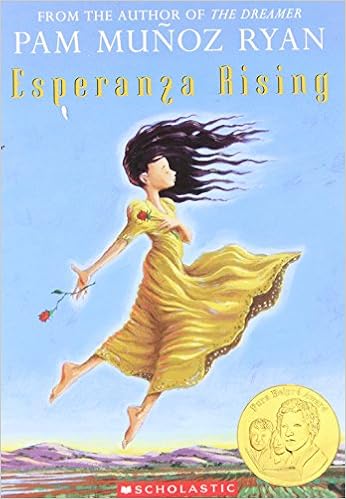
Hispanic citizens have had a profound impact on the culture of the United States from language to food to weaving their culture into the strength of the melting pot which is our country.  A fine example of this is the children's book, Esperanza Rising by Pam Munoz Ryan.
Americans observe National Hispanic Heritage Month from September 15 to October 15, by celebrating the histories, cultures and contributions of American citizens whose ancestors came from Spain, Mexico, the Caribbean and Central and South America.
Pan Munoz Ryan
The observation started in 1968 as Hispanic Heritage Week under President Lyndon Johnson and was expanded by President Ronald Reagan in 1988 to cover a 30-day period starting on September 15 and ending on October 15. It was enacted into law on August 17, 1988, on the approval of Public Law 100-402.
The day of September 15 is significant because it is the anniversary of independence for Latin American countries Costa Rica, El Salvador, Guatemala, Honduras and Nicaragua. In addition, Mexico and Chile celebrate their independence days on September 16 and September18, respectively. Also, Columbus Day or Día de la Raza, which is October 12, falls within this 30 day period.

Wednesday, September 9, 2015

Her Brown Hair Book Review

Another inspirational children's book from Jill Dana, the first called Her Pink Hair. Both are published by Guardian Angel Publishing. 


Children’s Book on Friendships and the Love of Books – Her Brown Hair by Jill Dana

Her Brown Hair is a must-read for kids between the ages of five to eight and is a sensitive look at childhood cancer.  This book concerns two best friends, one with cancer and one without.  It addresses the issues of concern, and sadness, and fear of the unknown, in a gentle and sympathetic way. 

The friends are known only as 'she' and 'I," and it works.  While she is in the hospital, her best friend worries and thinks of ways to cheer her up, and I believe to make herself feel better as well.

Jill Dana
The illustrations, created by Ms. Dana, are made of mixed media clay, done in a mixture of pastel and somewhat brighter colors. The love and care of the author/illustrator is ever present in the attention to detail in every aspect of the story's pictures. They are simple, yet complete and give a picture of wholeness within the story's context. 

Jill Dana is an author, illustrator, artist, teacher, and
filmmaker. She is a certified elementary educator with a Master of Education from FAU. She is an award-winning filmmaker with an MFA in film and television production from USC. She also studied psychology and motion pictures at the University of Miami.  Please visit:

 www.jilldanabooks.com

As September is Children's Cancer Month, what better to recognize it than purchasing a copy of this worthwhile book for your young ones.

Sunday, August 30, 2015

Still Banning Kids' Books? Really?

We have to ask ourselves the timeless questions:  Are kids' books still being banned?  Why?  And by whom?  The answers are as varied as children themselves.  This blogger believes a couple of words could readily sum it up:  fear and ignorance.

According to the American Library Association, 2014 saw 311 book challenges. That’s 311 times that some adult decided that not only did they not want their kids reading a particular book, but that they also wanted to keep others from getting the opportunity.


Banning books give us silence when we need speech. It closes our ears when we need to listen. It makes us blind when we need sight.
Stephen Chbosky, author of The Perks of Being a Wallflower.
 Have a look at the top 10 most challenged books of the 21st century, you see literary classics like The Bluest Eye and Brave New World alongside fun tales like Bone and Captain Underpants.
Here are some examples of banned or challenged books and the reasons given:
Winnie-the-Pooh has been banned because he has no clothes on.  No animal nudity, please!

Another banned treasure is:  Where the Wild Things Are.  The reason for banning is "that it glorifies bad behavior." 
Another example of classics banning is:  The Wonderful Wizard of Oz.  Reason given:  The book showcases women having too much power.  In 2004 both Jerry Falwell and Pat Robertson conspired to get the movie banned from broadcast on public television because of “moral turpitude.”

Robertson would publicly state that “The Almighty told me that flying monkeys and witches are an affront to all good Christians.”  When asked at the time if either had ever seen the movie or read the book, they denied, saying that they “feared ungodly influence."  As recently as 2004, Pat Robertson and Jerry Falwell tried to have the film banned because of its "wicked flying monkeys."

Perhaps the point has been made here that book banning is an affront to freedom.  Parents do have the right to govern what their minor children read.  In a democracy, they do not have the right to actively ban books so other parents and their kids cannot make up their own minds about the books under attack.

Saturday, August 22, 2015

Reading to Young Children Can Change Their Lives Forever

A remarkable, but not surprising study has revealed some concrete benefits of reading to your children.  It was conducted at the Reading and Literacy Discovery Center at Cincinnati Children’s Hospital. I thought it was important enough to repeat in my blog, something I usually do not do.

When parents read to their children the difference shows in their behavior and academic performance. And according to the study study, the difference also shows in their brain activity. Researchers looked at children ages 3 to 5 who underwent brain scans (MRI) while listening to a pre-recorded story. The parents answered questions about how much they read to, and communicated with, their children.
The researchers saw that, when the young children were being told a story, a number of regions in the left part of the brain became active. These are the areas involved in understanding the meaning of words and concepts and also in memory. The same was true when older children listen to stories or read.
This study shows that the development of this area starts at a very young age, said Tzipi Horowitz-Kraus, program director and one of the authors of the study.  Horowitz-Kraus is one of the authors of the study, which was published  in the Journal of Pediatrics.
Even more interesting, according to Horowitz-Kraus, is how the brain activity in this region was higher among the children whose parents reported creating a more literacy-friendly home: 

The more you read to your child the more you help the neurons in this region to grow and connect in a way that will benefit the child in the future in reading.
The American Academy of Pediatrics recommends that parents start reading out loud to their children from the time they are born.
Site TitleThe researchers looked at a number of measures to gauge whether homes were literacy-friendly, including how often children were read to and whether they had access to books and the variety of books. The research team is now looking at which of these aspects contributed the most to stimulating children’s brain activity, Horowitz-Kraus said.
Before this study, a large body of research has shown that children who are exposed to books at a young age go on to do better on a wide variety of measures, said Dr. Barry Zuckerman, professor of pediatrics at Boston University School of Medicine. They have better vocabulary, higher literacy, pay attention and concentrate better, and are better prepared to go into kindergarten, he said
 Although it remains to be seen how children who have lower levels of brain activity will fare in the future, “I would speculate that it is an effect that lasts,” Horowitz-Kraus said. “The brain develops rapidly from zero to six years of age, and the more exposure, the more you enrich and nurture these brain networks that are related to social and academic ability, the more the kid will gain the future.”
There are benefits of parents reading to their children beyond the child’s performance, too. “It’s one of the most pleasurable activities that you do with your child — there’s physical closeness but it’s probably the most unhurried time that children have with their parent and it is focused on them,” Zuckerman said.

Saturday, August 15, 2015

Why Are So Many Adults Reading Young Adult Fiction?


 What is the allure these days of young adult books and their crossover appeal to the adult crowd the world over?  Many YA books, in fact, are standouts with the adult community.  This industry has grown astronomically to become worth millions of dollars worldwide, with authors such as JK Rowling and Suzanne Collins.  In fact, (55%, according to a 2012 study), are actually adults. So what's the reason?
Perhaps the real mystery, then, is not why the works of the authors above have been so successful commercially, but why they, and other books like them, have appealed to so many people beyond their target audience. This in itself creates a sub-mystery, too: why do these books remain popular years after they are first published, and what is it about society today that means that their messages and values are still applicable to us?

One reason is that adults have discovered this: that young adult authors are doing some of the most daring work out there. Authors who write for young adults are taking creative risks -- with narrative structure, voice and social commentary -- that you don’t see as often in the more rarefied world of adult fiction.
YA books can be a vehicle for evoking nostalgia; they can often remind older readers of their childhoods and teenage years.  Society nowadays is so intricately and overwhelmingly critical of YA, and yet it is its simplicity that often provides the most pleasure for young people and adults alike.
Their universal appeal is palpable New generations of young people grow up, and they are often found reading the same books as their predecessors due to the sheer quality and sense of purpose behind the writing, making them applicable to anyone, at any time.

So to all of my adult readers out there:  Check out a few young adult books.  See if you feel nostalgic, or excited, or better for having read your choice.  You may be surprised!

Friday, August 7, 2015

Children's Books That Have Paved the Way to Legitimize LGBT

With (finally) an emphasis on LGBTQ books for young people, let's take a look at some of the ones that literally paved the way for those to come. With all the talk of needing books about diversity, this type of book along with transgender offerings, are becoming if not quite mainstream, non-squeamish and accepted by much of the population. 
heatherhas
Heather Has Two Mommies by Lesléa Newman and Diana Souza (1989) 
This book tells the story of a child with same-sex parents. New plot points include artificial insemination and an inclusive discussion at Heather’s playgroup about different family structures. In real-life playgroups, the response to this book was far less benign: the story rocked the U.S., and the resulting controversy led to extensive parodies including a "Simpsons" version: “Bart Has Two Mommies.”
Asha’s Mums by Rosamund Elwin, Michele Paulse and Dawn Lee (1990) 
ashasmumsAsha needs to get a permission slip signed by her mother, but she is perplexed when she must decide which of her two moms to ask. While Heather was lucky enough to have an accepting playgroup, Asha confronts a far less hospitable school -- and world. It’s a tale for anyone whose family does not fit into educational bureaucracy, and Asha’s African-Canadian identity marks a decisive step away from lily-white characters
.
daddysroommate
Daddy’s Roommate by Michael Willhoite (1991) 
You might recognize the name from the 2008 presidential campaign when it “came out” that Sarah Palin, back in her 1995 councilwoman days, had said the book should not be permitted in public libraries. Why? There’s a gay relationship between the the father and his new roommate-actually-boyfriend, Frank. Plus it all starts off with a divorce and arrives at a pretty clear message: “Being gay is just one more kind of love.”
andtango
And Tango Makes Three by Justin Richardson, Peter Parnell and Henry Cole (2005) 
A tale of two male penguins who are chick-less until a zookeeper helps them adopt Tango from a heterosexual couple. Animals are always one of the easier ways to discuss unconventional story lines, but that didn’t stop Singapore from banning the book along with two others last year. In fact, it’s ranked third on ALA’s list of “Most challenged books of the 21st century,” which is hard to explain considering how heartwarming these polar birds are. Did we mention it’s based on real gay penguins at the Central Park Zoo?
mynewmommy
My New Mommy by Lilly Mossiano and Sage Mossiano (2012) 
Who says transgender identity can’t be explained to young children? Four-year-old Violet has a transitioning father who carefully walks her -- and us -- through the process. Like Daye and Johnson, Mossiano was frustrated with the lack of children’s materials, so she took matters into her own hands. She challenged herself to make the content accessible to a young audience, but the real challenge is the one she posed to traditional portrayals of gender in children's books.


Sunday, August 2, 2015

Star Wars is Coming to a Golden Book Near You!

With new games, shows, and movies all on the way, watch out for Star Wars!  The series is back in a different format.  Disney recently announced that the entire saga is launching a new series of Little Golden Books for kids.
The Star Wars Little Golden Books will soon join the iconic series of children's books that have been around since the 40's. Each book is designed to capture a single movie in the six-film saga, and will feature writing and artwork from different creative teams as well as those gold spines we all grew up with.
The Star Wars franchise has woven itself into the hearts and minds of generations of fans, many of whom read Little Golden Books as children," said Jeanne Mosure of Disney Publishing Worldwide in the official release: 
We’re very excited to be incorporating Little Golden Books into our overarching strategy so parents can now introduce their own children to the wonders of the galaxy through this classic format.

Entertainment Weekly debuted the covers for all six books — adaptations of The Phantom Menace, Attack of the Clones, Revenge of the Sith, A New Hope, The Empire Strikes Back and Return of the Jedi. They all have that signature golden spine, but instead of the classic decorations of filigree, flowers, bees, vines and the like, these spins have little icons of Star Wars characters. How cool is that!

The books became available on July 28th, with a complete boxed set being released on September 1st.

Sunday, July 26, 2015

More Book Banning in Italy?


What is happening to children's literature in Italy, particularly in Venice?  Luigi Brugnaro took over as mayor of Venice in June, many people thought his priorities might clean up corruption that rocked Venice with over-funded protective floodgates.

Instead, Brugnaro focused on cleaning up the city's primary schools, namely 49 so-called "dirty books" touching on issues such as non-traditional families and gender issues.

The banned books are among 1,098 new books for children that the Venice school district paid some €10,000 for in 2014. The blacklist includes titles from award-winning Italian and international children’s authors like Leo Leonni, whose book Little Blue and Little Yellow tells a fictional tale of two genderless circles that hug so hard they become green.

Another banned book—called What’s Dad’s Secret?—tells a tale of a divorced father whose children worry he has a terminal disease when he starts acting strange around them, only to be overjoyed to learn that instead he has simply fallen in love with his male friend, Luca.
And there’s I’m Not Like The Others by French author Janik Coat, which is about animals that are different from their traditional species, which is as much about physical and religious differences as it is about sexuality.

Public pressure could have an influence on the book ban. Last week, 263 Italian and foreign authors whose books are in Venice schools sent a letter to the mayor asking that their books also be removed from schools as a show of solidarity with the banned authors.

Venetian residents are also holding Flashmob-style read-ins of the books in public venues, and they have started a Facebook page called “Free our Books” where they post pictures of children reading the banned books.

As a personal aside, this blogger has just returned from two weeks in Rome, Ravenna, and Loro Piceno.  Democracy was palpable, as was thoughtfulness, and an aura of judiciousness.  One can only hope the honorable mayor of Venice will reconnect with the Italian citizens who protest his outrageous actions.